PicoClaw vs Mac Mini AI — The Controversial Showdown: $10 Edge Agent or $600 Desktop Brain?
A controversial, evidence-backed comparison of PicoClaw (an ultra-lightweight Go AI agent that runs on <$10 hardware) and the Mac Mini (Apple’s powerful desktop platform for local AI). We analyze cost, performance, privacy, developer experience, real-world use cases, and hidden trade-offs — with sources and SEO keywords included.
TL;DR — The Hot Take
PicoClaw is a technical stunt and a practical milestone: an ultra-light AI orchestration layer written in Go that demonstrates personal agents can be extremely small and cheap to run. The Mac Mini is a legitimate powerhouse for local, low-latency model inference and creative workflows, but it’s expensive, power-hungry, and overkill for many edge use cases. The controversial claim: PicoClaw exposes a new truth — most day-to-day “AI assistant” tasks don’t require Mac-class hardware; what they need is smarter orchestration and better security practices. (Sources: PicoClaw project pages; Apple Mac mini tech specs.) (GitHub)
Why this is controversial
There are two communities that rarely agree:
- The “more compute is always better” camp — who point to high-parameter models and local inference as the gold standard for privacy and latency.
- The “smart orchestration & edge” camp — who argue small agents + cloud LLMs or tiny local models + clever engineering can deliver meaningful, private, affordable AI experiences.
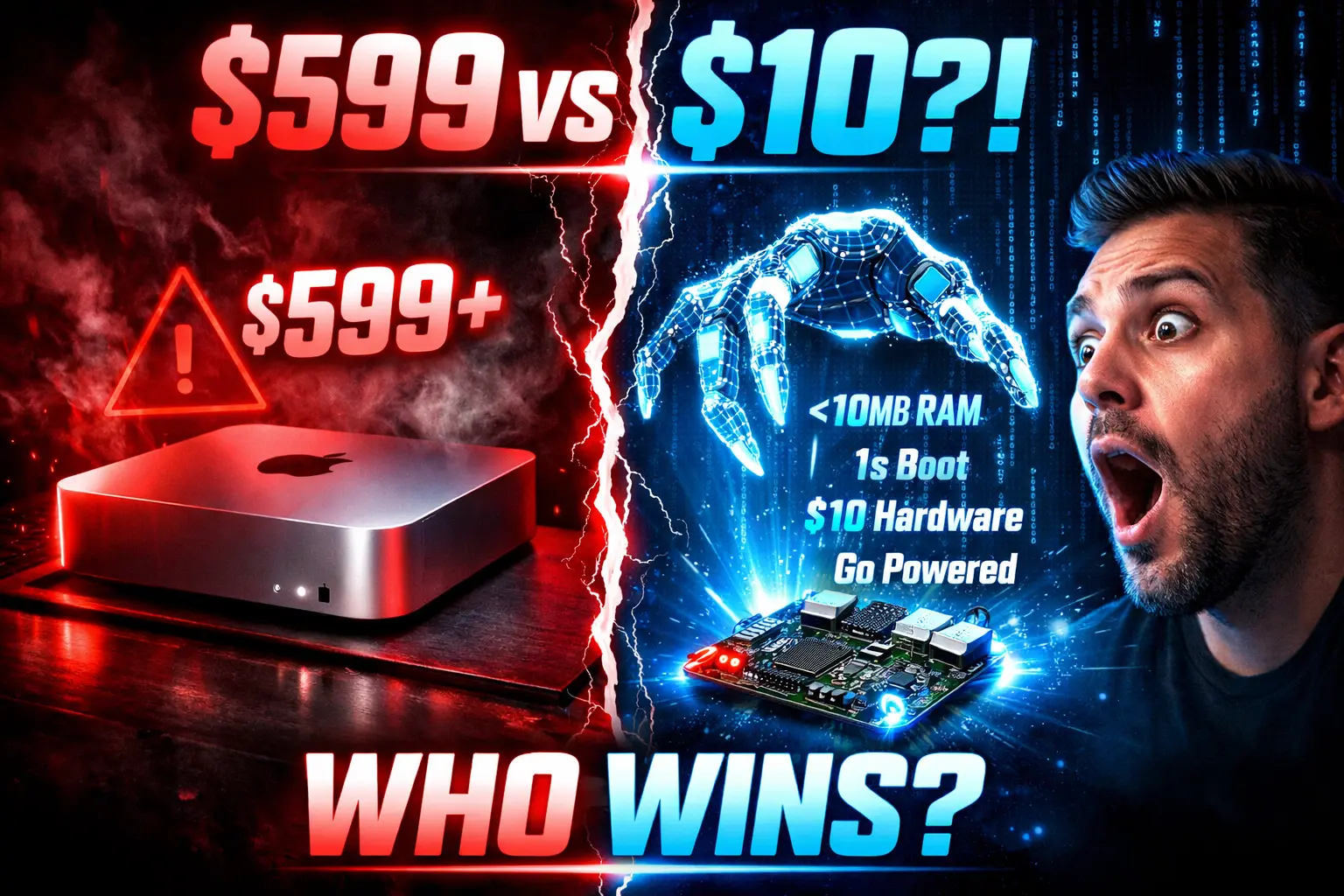
PicoClaw sits provocatively in the second camp. It claims production-level usefulness on devices that cost a fraction of a single Mac Mini. If taken seriously, that threatens the narrative that personal AI must be centralized on powerful machines or expensive cloud infrastructure. Evidence: PicoClaw’s repo and website tout <10MB memory usage and <$10 hardware deployments. (GitHub)
Quick primer: what are we comparing?
PicoClaw — An ultra-lightweight AI agent/orchestrator written in Go, designed to run as a single static binary across x86_64, ARM64, and RISC-V, with claims of <10MB RAM and ~1s boot time. It’s intended to orchestrate tasks, connect to LLM providers, schedule jobs, and run as a sandboxed assistant on tiny boards. (GitHub)
Mac Mini — A modern Apple desktop (M2/M4 family) with powerful unified memory, a Neural Engine, and a GPU capable of local model inference and heavy developer workflows. It costs hundreds to thousands of dollars depending on configuration. Official spec pages list M2/M4 chip capabilities, unified memory bandwidth, and neural engines optimized for inference. (Apple)
Head-to-head: cost & hardware
PicoClaw
- Target hardware: RISC-V / ARM single-board computers (e.g., LicheeRV Nano). These boards can retail for ~$10–$50 depending on version and seller. PicoClaw claims it can run on $9.9 boards. That’s dramatic price accessibility. (Robu)
Mac Mini
- Base Mac Mini configurations start at several hundred dollars (and can go well above $600 for Pro/M4 variants). The hardware is orders of magnitude faster and supports on-device neural acceleration. (Apple)
Controversial conclusion: For basic assistant tasks (scheduling, search orchestration, simple automations), a $10 board + PicoClaw can be functionally sufficient. Spending $600+ on a Mac Mini for these tasks is wasteful unless you specifically need local heavy inference, complex media workflows, or high I/O performance.
Memory, startup time and what they really mean
PicoClaw emphasizes <10MB memory footprint and <1s boot. That is not the same thing as running large LLMs locally — it means the coordinator/agent is tiny. The practical consequence:
- Instant availability for low-latency control tasks (cron jobs, CLI agent interactions, peripheral monitoring).
- Low power draw and always-on capability on micro-controllers.
- Necessarily still dependent on external LLM providers (or tiny models) for heavy natural language reasoning if you want sophisticated responses. PicoClaw’s config shows integrations to OpenRouter, Zhipu, Anthropic, etc., indicating it primarily orchestrates calls to external models. (GitHub)
A Mac Mini, in contrast, boots OS X and apps relatively quickly but cannot match the “tiny bootstrap” claim — it offers the ability to perform local model inference on larger models (if you have the model and disk space), which matters for certain privacy-sensitive or offline scenarios. (Apple)
Performance & latency — apples-to-oranges
Local heavy inference (Mac Mini): If you host a local LLM (Llama family, Mistral, Mixtral, etc.) and have GPU/Neural Engine support, you can get deterministic, offline low-latency inference — but you need local model storage, memory, and often specialized libraries. Mac Mini can do this well. (Apple)
Orchestration + cloud inference (PicoClaw): PicoClaw offloads model inference to providers. The agent itself is lightweight and fast, but end-to-end latency will depend on network and the chosen provider. For many use cases (scheduling, summarization, reading mail), that latency is acceptable and the cost savings are huge. PicoClaw supports Brave Search fallbacks and multiple LLM providers. (GitHub)
Controversial claim: For most “assistant” queries (calendar, reminders, search summaries), the marginal latency/accuracy gains from running large local models on a Mac Mini often do not justify the price difference. The Mac Mini wins for heavy local inference, but PicoClaw wins for cost-efficiency and instant responsiveness for trivial-to-medium complexity tasks.
Privacy, security & supply chain — the real tradeoffs
Mac Mini (local-first)
- Advantage: On-device inference can keep sensitive data off cloud APIs.
- Disadvantage: If you run third-party models or connectors, misconfigurations can leak data. Also, local models may require frequent updates and security patches.
PicoClaw (edge orchestrator)
- Advantage: Small attack surface for the agent itself (sandboxed workspace, restricted exec). It’s easier to audit a 4k line Go codebase than a huge Python stack. PicoClaw enforces workspace isolation and blocks dangerous commands. (GitHub)
- Disadvantage: When it calls cloud LLMs, your data traverses remote APIs. Unless you use private models or on-prem providers, you trade privacy for cost and scale.
Important reality: Both approaches have attack surfaces. The controversy is that PicoClaw’s small runtime encourages deployment on many low-cost devices, increasing the number of endpoints to secure. Conversely, pushing everyone to local Mac Minis centralizes hardware costs and reduces the number of widely deployed endpoints (but concentrates risk and cost). See the PicoClaw sandbox/security docs for its mitigations. (GitHub)
Developer experience & ecosystem
PicoClaw
- Written in Go, single-binary distribution, simple cross-compilation, small codebase (in spirit similar to nanobot). Great for DevOps, firmware, and embedded developers. It integrates with Telegram, Discord, QQ, LINE, and typical LLM providers out of the box. (GitHub)
Mac Mini
- Full desktop dev environment, rich tooling, native support for many ML toolchains and GPU libraries. Ideal for model developers, video producers, or anyone who needs standard macOS app ecosystem.
Controversial claim: PicoClaw’s smaller, auditable codebase may be better for organizations that value code transparency and tiny attack surfaces. Mac Mini is better where local inference and heavy local tooling are priorities.
Real-world use cases: who should pick what?
Pick PicoClaw if:
- You want to run personal assistants on cheap SBCs and scale cheaply.
- Your tasks are orchestration, scheduling, notifications, local automation, or simple Q&A that can rely on cloud LLMs.
- You need always-on, low-power agents for IoT nodes. (Robu)
Pick Mac Mini if:
- You require heavy local model inference, multimedia workflows, or offline operations with large models.
- You need professional creative tooling (audio/video) that benefits from macOS acceleration. (Apple)
The elephant in the room: what PicoClaw cannot (yet) do
PicoClaw’s architecture is intentionally minimal. That means:
- It’s not a drop-in replacement for hosting full LLM weights locally — it orchestrates.
- Model fidelity for complex reasoning may lag if you rely on tiny local models or budget cloud providers.
- Security of endpoints becomes a scaling problem if you deploy many cheap devices without central management. GitHub issues show active feature requests and integrations being added, indicating rapid iteration but also early-stage instability. (GitHub)
The wild cards: community, momentum & competitive landscape
- PicoClaw is early: The repo and site indicate rapid growth and active development — it’s a community-first project from Sipeed with public releases and issues. That momentum matters because the value of a small agent increases with developer contributions. (GitHub)
- OpenClaw & nanobot influence: Projects like OpenClaw and nanobot popularized personal agents; PicoClaw is the “tiny Go answer” to these movements. Recent news about OpenClaw and its founder moving into larger ecosystems shows the space is maturing quickly — and competition will push both cloud and edge innovation. (GitHub)
Balanced verdict (with a jab of controversy)
- If you want privacy-first, offline, heavy inference, and professional workflows, choose a Mac Mini or comparable local workstation.
- If you want scale, affordability, and enough capability to automate real-world tasks — at an absurdly low price — PicoClaw is a revelation.
Provocative assertion: For a large portion of “assistant” use cases (scheduling, alerts, search summarization, small automations), spending on local Mac-class hardware is often unnecessary. The proper counterargument is: when you need high fidelity or no cloud dependence, Mac Mini wins — but that majority of user interactions do not. The controversy is whether we should optimize for “the worst-case model” (run everything locally on beefy hardware) or the “common case” (orchestrate cheaply, scale widely). PicoClaw pushes us to rethink default assumptions. (GitHub)
Sources & further reading
(These are the top sources used to research claims in this article.)
- PicoClaw GitHub repository — project readme, install, architecture notes. (GitHub)
- PicoClaw official site (picoclaw.net) — feature summary and quick start. (PicoClaw)
- PicoClaw coming soon / Sipeed project page (picoclaw.io). (picoclaw.io)
- Apple Mac mini technical specifications (M2/M4 details). (Apple)
- Sipeed LicheeRV Nano product listings and price references (examples of <$10–$50 boards). (Robu)
- nanobot (lightweight agent inspiration) — shows tiny agent design patterns. (GitHub)
- TinyML / Edge AI academic overview (TinyML enabling small models). (MDPI)
- PicoClaw GitHub issues — snapshot of current development, feature requests, and active community work. (GitHub)
- News coverage of OpenClaw and the broader “personal agent” movement (context on community momentum). (Reuters)
Actionable checklist — Deploy decisions
If you’re deciding today:
- If budget ≤ $50 and need basic assistant features → Try PicoClaw on a LicheeRV/Nano board. Follow the GitHub quick start to onboard. (GitHub)
- If you need offline local LLMs, multimedia workloads, or high single-user performance → Invest in a Mac Mini or an equivalent workstation and set up a local model runtime. (Apple)
- If security/privacy matters but you still want edge scaling → consider hybrid: PicoClaw + a self-hosted LLM provider on a private server, minimize cloud use.
Final provocative line
PicoClaw forces a choice: pay for brute force (Mac Mini) or build smarter and distribute (PicoClaw). Both models are valid. The controversy is cultural more than technical — and the rise of ultra-light agents means we’ll be arguing about that for years. Which side are you on?
keywords
Primary keywords
- PicoClaw
- PicoClaw vs Mac Mini
- lightweight AI assistant
- AI agent on $10 hardware
- Go AI assistant
Secondary keywords
- edge AI PicoClaw
- tiny AI agent RISC-V
- Mac Mini local LLM inference
- self-hosted AI assistant
- sandboxed AI agent
Long-tail keywords
- run AI assistant on $10 board
- PicoClaw <10MB RAM boot 1s
- Mac Mini vs cheap SBC for AI
- secure personal AI assistant Go
- picoClaw orchestration vs local model inference