Rising Cigarette Prices in India: Causes and Economic Impacts
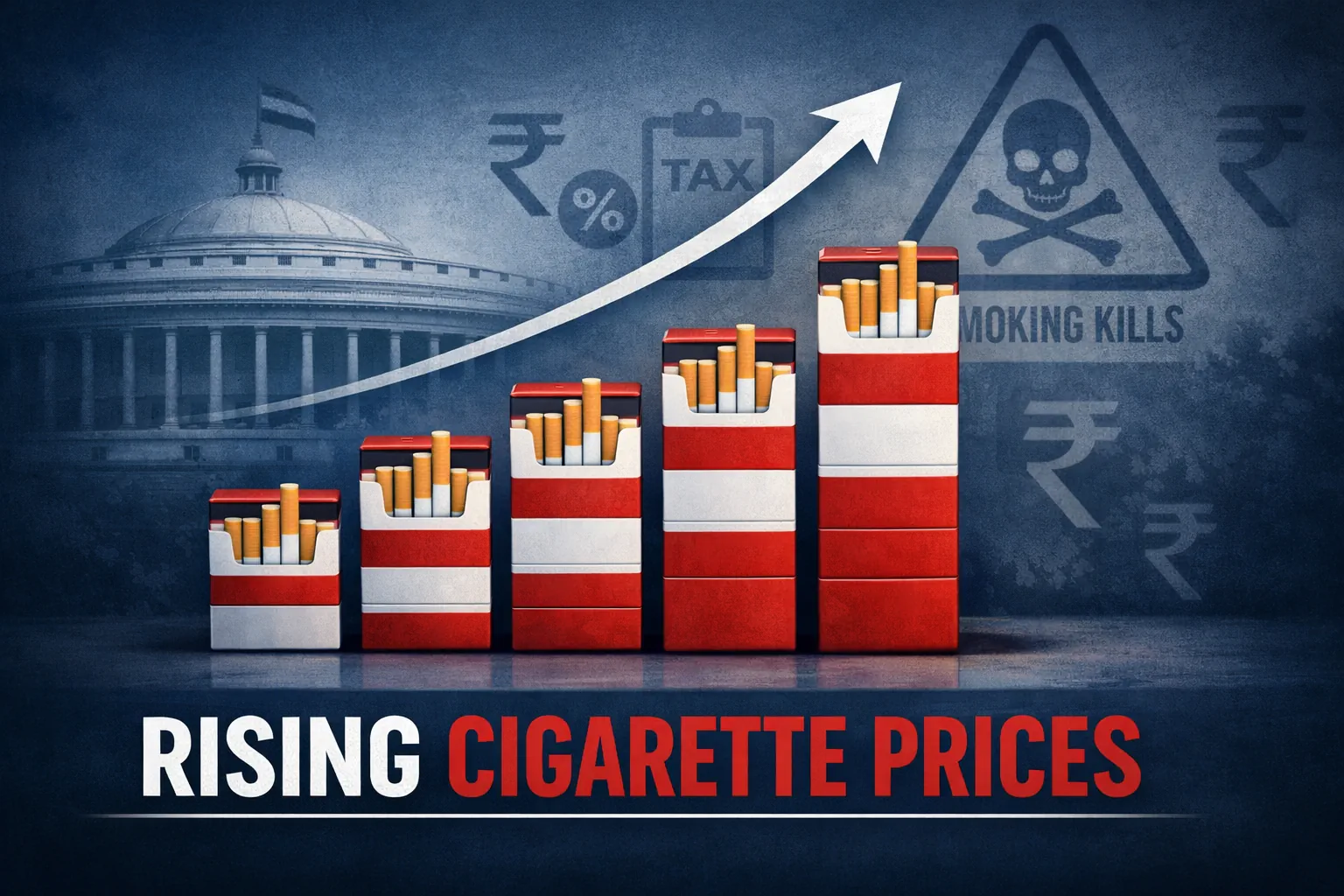
India's Parliament approved major tobacco tax reforms in late 2025, driving cigarette prices up 25-40%. The new excise duties aim to reduce smoking rates, improve public health outcomes, and boost government revenue while aligning with WHO recommendations for tobacco control.
Rising Cigarette Prices in India: Causes and Economic Impacts
In late 2025 India’s Parliament approved a major tax overhaul on tobacco, driving cigarette prices sharply higher. Under the new rules (effective Feb. 1, 2026) a value-based excise duty of ₹2,050-8,500 per 1,000 sticks will be levied in addition to the existing 28% GST. In effect this raises the total tax incidence on cigarettes from roughly 50-55% to about 60-70% of retail price[1][2]. Finance Minister Nirmala Sitharaman framed the move as a deliberate discouragement of smoking: “Certainly we don’t want cigarettes to become affordable,” she told Parliament[3]. Indeed, total taxes on Indian cigarettes now cover only about 53% of retail price - well below the 75% benchmark recommended by the WHO for effective tobacco control[4]. The new law aligns India more closely with global best practices, while also boosting government revenue (see Table 1).
Several factors underlie the tax hike. First, India’s huge tobacco health burden - about 1.3-1.4 million smoking-related deaths per year (WHO estimate)[5] - has put pressure on policymakers to curb consumption. Cigarettes, though only ~10% of total tobacco use, generate the vast majority of excise revenue (currently ~80% of tobacco tax receipts[6]). Higher taxes thus serve dual goals: reducing smoking (a public health priority) and increasing government coffers. The measures form part of India’s broader tobacco control strategy (which includes large warning labels and smoking bans). As one Finance Ministry official noted, even after inflation-adjustment cigarette prices in India have lagged behind income growth[4], making them more affordable over time - a trend the new taxes are intended to reverse.
Tax Changes and Price Effects
Under the previous system, cigarettes incurred a basic excise duty and an NCCD (a fixed cess), plus 28% GST and compensation cess. The overall tax share averaged around 53-55% of retail price[4]. The new tax regime replaces the cess structure with higher specific duties: ₹2,050-8,500 per 1,000 sticks (by length), plus 40% GST. Industry analysts estimate this will require raising retail prices by roughly 25-40% for most brands[7][8]. For example, JP Morgan projects a ~27% weighted average price rise, with proportionally larger hikes on premium (longer) cigarettes[9]. Legal cigarette companies (e.g. ITC) have already signaled intentions to pass on much of the duty increase to consumers, partly to protect margins[10]. The table below shows the rapid rise in government excise collections on cigarettes in recent years, reflecting earlier duty hikes and improving enforcement:
| Fiscal Year | Cigarette excise collected (₹ Crore)[11][12] |
|---|---|
| 2019-20 | 1609.8[11] |
| 2020-21 | 4962.5[13] |
| 2021-22 | 5806.7[12] |
| 2022-23 | 7058.1[12] |
Source: Indian Finance Ministry (Rajya Sabha answer)[11][12].
As noted above, even after these increases India’s cigarette taxes (53% of price) remain below WHO’s minimum 75% recommendation[4]. Table 2 compares India’s current tax share with the WHO benchmark:
| Tax metric | India (2025) | WHO minimum |
|---|---|---|
| Total excise and GST on cigarettes | 53% of retail[4] | ≥75% of retail |
With the new duties, India moves closer to the WHO target. Overall, economists agree that higher excise taxes (and thus higher prices) are the single most effective lever to curb smoking. Studies consistently find that raising cigarette prices reduces consumption, especially among youth and low-income smokers[14][15]. (In low- and middle-income countries a 10% price hike typically cuts cigarette demand by ~5%[14][16].) Thus one driver of the price rise is public health: making smoking less affordable to deter use.
Consumption and Health Benefits
If past patterns hold, the price jump will induce many smokers to quit or cut back. Recent Indian research quantifies large health gains from big tobacco tax hikes. For instance, Wu et al. (2020) modeled a one-time price increase of ₹10 + 10% ad valorem. They projected about 1.5 million men quitting and ~665,000 lives saved across four large states[17]. The poorest income group gains the most, with quitters ~7-8 times those in the wealthiest quintile[17]. Another study estimated that a 50% tax hike could avert ~1.8 million deaths over ten years in India, yielding 66.8 million “healthy life-years” gained[18].
These quitters also translate to economic dividends. The Wu et al. analysis found that healthcare costs averted (from treating smoking diseases) could reach ₹1,729 crore, with roughly 454,000 households avoiding catastrophic medical spending[19]. The increased excise would raise ~₹4,385 crore in additional tax revenue in those four states alone[20]. Nationally, experts note, a cigarette tax rise is “pro-poor” because low-income smokers pay more tax and receive larger health benefits[17]. A recent microsimulation similarly projected that doubling India’s tobacco tax could yield an economic benefit (after accounting for costs) of over ₹11.9 trillion in ten years, in addition to preventing ~1.8 million deaths[18].
In sum, higher cigarette prices should cut smoking rates and improve public health. That frees families from spending on tobacco and saves government money on health care. It can also boost productivity by reducing illness. These benefits complement the direct fiscal gains (next section).
Fiscal and Economic Impact
The new taxes will provide a substantial revenue windfall for the government. Even before this latest hike, tobacco duties were a big revenue source - a fact reflected in the data above. Independent analysis notes that tobacco taxes (including cigarettes, beedi, chewing tobacco etc.) made up about 2.2% of India’s total tax revenue in FY2023-24[21]. This share actually peaked at ~2.75% in 2019-20 (largely on cigarette taxes)[21].
The fresh increase in cigarette duties is expected to raise this share further. In dollar terms, Factly reported that tobacco (mostly cigarettes) generated ₹86,175 crore in 2023-24 for health programs and other budget items[22]. With higher rates, government analysts estimate that every ₹1,000 per pack price hike yields hundreds of crores in extra revenue. For example, the Wu et al. study found ~₹4,385 crore extra from the modeled hike in four states[20]. Aggregating nationally, conservative forecasts suggest cigarette excise collections could double relative to a decade earlier. (Indeed, as Table 1 shows, cigarette excise rose more than fourfold between 2019-20 and 2022-23.)
These taxes fund public health and other services. The government can earmark some revenue for anti-tobacco campaigns or universal health coverage. Even beyond direct health spending, increased revenues help India’s fiscal position, potentially freeing up resources for infrastructure or welfare programs. In macroeconomic terms, diverting even a fraction of tobacco spending (currently ~₹1 lakh crores annually) away from cigarettes could raise GDP: the World Bank notes that tobacco-related diseases cost India ~$36.2 billion each year (lost productivity and healthcare)[23]. Reducing that burden is an economic gain.
Key points: Research indicates that significantly higher tobacco taxes in India would generate large fiscal and social returns - for example, preventing hundreds of thousands of smoking deaths, avoiding healthcare costs, and raising government revenue by thousands of crores[17][18]. It is widely described as a “no-brainer” policy for health and development (WHO).
Potential Downsides and Market Response
Critics warn of potential downsides. Industry and analysts note that very steep taxes on an inelastic good can fuel illicit trade. For instance, brokerage reports and health experts in India have cautioned that a 60-70% tax incidence might drive smokers to contraband products[8][24]. Times of India reports that about 26% of India’s cigarette market is already illicit[8], and warns that an “unprecedented” tax spike could make the problem worse[25]. Historical examples support this concern: Australia’s repeat tobacco tax hikes (2012-2020) saw the illicit share jump from <2% to ~14%[26].
Another impact is on tobacco companies and related jobs. Stock markets reacted negatively: on Jan 1, 2026, shares of major cigarette firms plunged after the tax announcement. Brokers have downgraded firms like ITC, projecting double-digit declines in cigarette volumes[27]. These are short-term industry impacts, but could have modest local effects (for example, on employment in manufacturing). Some analysts suggest scaling up enforcement and anti-smuggling measures to mitigate illicit trade risks. Notably, the Finance Ministry still has a window to tweak rates before Feb. 1, 2026 - and officials have reportedly discussed such issues at GST Council meetings.
Despite these challenges, the consensus among economists and public health officials is that the net effect will be positive. A modelling study by the WHO’s Tobacco Free Initiative found that any lost revenue from illicit sales is outweighed by the long-term gains in health and productivity when tax hikes are well-enforced[26][20]. High taxes also keep overall cigarette affordability in check. TII data (an industry group) note that even with heavy taxes India’s cigarettes cost on average only about 9.8% of GDP per capita per pack-year - meaning still room to raise prices without pricing out low-income smokers entirely[28][29].
Conclusion
In summary, India’s recent surge in cigarette prices stems from aggressive new excise taxes aimed at cutting smoking and bolstering government finances. The tax hikes (roughly a 25-40% jump in price for most brands[30][8]) are consistent with global evidence that steeper tobacco taxes save lives and raise revenue. Early research suggests the policy will significantly reduce smoking prevalence and avert disease burden, while increasing fiscal resources by several thousand crore rupees annually[17][18]. As one expert put it, properly calibrated tobacco taxes are “the only win-win policy in public health economics” - improving population health and government budgets simultaneously (and disproportionately helping the poor)[17][18].
Table 2. Cigarette taxation in India (2025) vs WHO target. India’s total cigarette tax share (excise + GST) is currently ~53% of retail price[4], below the WHO-recommended minimum of 75%. Continued rate increases are intended to reach or exceed the WHO benchmark and thus drive down smoking rates.
| Tax component | India now | WHO target |
|---|---|---|
| Total excise/GST on cigarettes | ~53% of price[4] | ≥75% of price |
References
Record cigarette tax hike sparks wave of downgrades on ITC by four brokerages - Investing.com
India’s parliament approves law that could raise taxes on cigarettes - Reuters
[Tobacco Taxation Cigarette Taxation - TIIOnline](https://www.tiionline.org/industry-issues/taxation/) Indian Finance Ministry - Rajya Sabha Parliamentary Documents
Visualizing data: Trends in smoking tobacco prices and taxes in India - PMC
Impact of cigarette tax increase on health and financing outcomes in four Indian states - PMC
- Indian Finance Ministry - Collection of taxes from tobacco