Claude Code + Opencode Zen Real-World Cost Calculator: What You'll Actually Pay
A real cost breakdown for running Claude Code through Opencode Zen, using Anthropic's own published token pricing to work out what light, medium, and heavy usage actually costs against a flat Claude Max subscription.
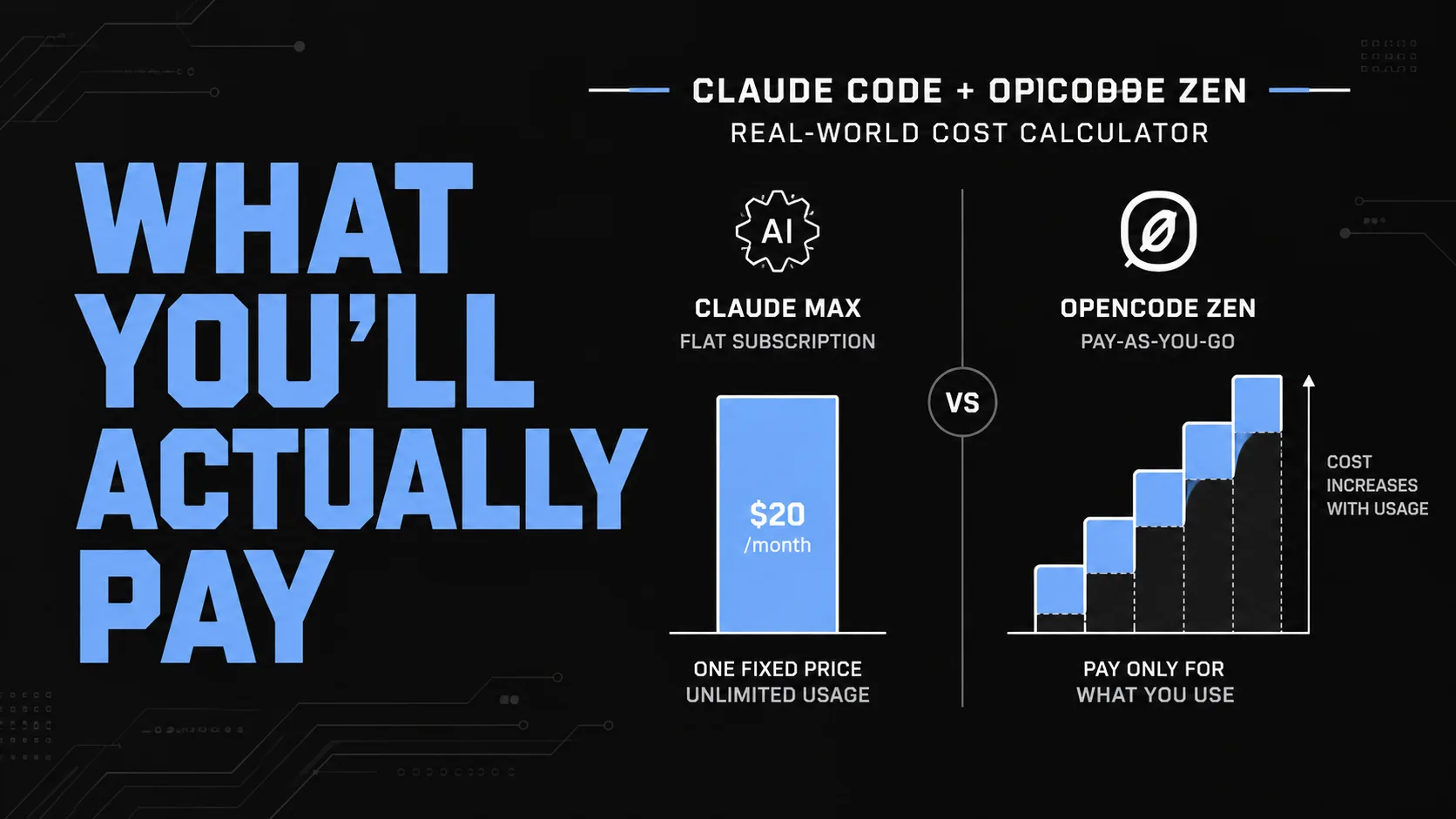
Claude Code + Opencode Zen Real-World Cost Calculator: What You’ll Actually Pay
Our guide to running Claude Code through Opencode Zen covers the setup. It doesn’t cover the part most readers actually ask about afterward: what does this cost once you’re using it every day?
The honest answer is “it depends,” but not in a hand-wavy way. It depends on which models you use, how big your sessions get, and whether you’d rather pay per token or pay a flat monthly fee. Below is the actual math, built from Anthropic’s published API rates and Opencode’s own pricing pages, not vibes.
Quick answer
Running real Claude models through Opencode Zen costs exactly what Anthropic’s own API charges, because Zen passes the rate through with no markup. For most solo developers doing a session or two a day, that lands somewhere between $5 and $30 a month, well under Claude Max’s $100 or $200 flat fee. Heavy daily users doing several long sessions a day can cross into $150 to $400 a month on pay-as-you-go, at which point Max’s flat rate starts to look better.
Three different ways to pay, and they’re not interchangeable
Claude Max is a flat Anthropic subscription. $100 a month for the 5x tier, $200 a month for the 20x tier. You get Claude models directly, no token math, and a usage cap that Anthropic doesn’t publish in exact numbers.
Opencode Go is a flat $10-a-month subscription from Opencode ($5 for the first month), with hard dollar caps: $12 per 5-hour window, $30 a week, $60 a month. It gives access to 19 open-weight coding models, things like Grok, GLM, Kimi, and DeepSeek. It does not include Claude models. If your whole reason for this setup is running actual Claude models inside Claude Code, Go isn’t the plan you want.
Opencode Zen pay-as-you-go is the one that actually matters for this comparison. You load a $20 balance (plus a processing fee, more on that below), and it auto-reloads $20 once you drop under $5. Zen’s catalog includes real Claude models at pass-through pricing, alongside a handful of genuinely free open-weight models. This is what the rest of this post is about.
The real pricing
Per Anthropic’s published API rates and Opencode’s own pricing page, here’s what Zen actually charges per million tokens:
| Model | Input | Output |
|---|---|---|
| Claude Opus 5 | $5.00 | $25.00 |
| Claude Sonnet 5 | $2.00 | $10.00 |
These numbers match Anthropic’s direct API pricing exactly. Zen’s “zero markup” claim checks out, at least for Claude models, when checked against Anthropic’s own rate card.
Zen also lists several models at $0 for both input and output: Big Pickle, DeepSeek V4 Flash Free, MiMo-V2.5 Free, Hy3 Free, Laguna S 2.1 Free, and a couple of Nemotron variants. None of them are Claude. If you use those, you’re getting Claude Code’s interface for free, but the model actually writing your code isn’t Claude, the same tradeoff covered in our setup guide.
On funding the balance: a $20 top-up carries a processing fee (Opencode quotes it as roughly $1.23 on the account page, with the underlying card-fee formula being 4.4% plus $0.30). Small, but worth knowing it’s there before you’re surprised by a $21.23 charge.
Building the actual calculator
To turn “$2 and $10 per million tokens” into “what will I pay this month,” you need a sense of how many tokens a real coding session uses. Published benchmarks for agentic coding sessions put it roughly like this:
- Light session (a quick fix or a focused question): 50,000 to 100,000 tokens
- Medium session (implementing a feature, chasing a moderate bug): 150,000 to 300,000 tokens
- Heavy session (a real refactor, deep debugging, a big feature): 400,000 to 800,000 tokens
Agentic coding sessions spend most of their tokens reading context, your files, your git history, tool output, not generating replies. A commonly used working assumption is roughly five input tokens for every output token. Using that ratio against Sonnet 5’s rate gives a blended cost of about $3.33 per million total tokens. Adjust this yourself if your workflow leans more output-heavy (tests, big diffs) or more input-heavy (huge codebases).
At that blended rate:
| Session type | Tokens | Cost per session |
|---|---|---|
| Light | 50k-100k | $0.17-$0.33 |
| Medium | 150k-300k | $0.50-$1.00 |
| Heavy | 400k-800k | $1.33-$2.67 |
What that looks like across a month
These are calculated scenarios, not published statistics, so treat them as a starting point to adjust against your own habits.
- Casual use, one light session most workdays: roughly $3 to $7 a month.
- Regular use, one medium session a workday: roughly $10 to $20 a month.
- Heavy professional use, a few long sessions a day: roughly $80 to $160 a month.
- Constant, automation-heavy use, several heavy sessions daily: roughly $200 to $400 a month.
So when does Claude Max actually win?
Max’s whole pitch is that the price doesn’t move no matter how much you use it, so the crossover point is what decides which one is actually cheaper for you.
At the $3.33-per-million-tokens blended rate above, you’d need to burn through about 30 million tokens a month to match Max 5x’s flat $100, and about 60 million tokens a month to match Max 20x’s flat $200. In session terms, that’s somewhere around one to two and a half heavy sessions a day for the $100 tier, and two and a half to five heavy sessions a day for the $200 tier.
Below that, paying per token through Zen is cheaper. Above it, Max’s flat rate wins, and you also skip tracking a prepaid balance.
The honest verdict
If you code in short bursts, students, side projects, weekend work, Zen’s pay-as-you-go plan will almost always cost less than either Max tier, and the free models cost nothing if you’re willing to skip Claude entirely for lighter tasks.
If you’re running Claude Code most of the day, every day, for client work or a full-time job, run your own numbers against the table above before assuming pay-per-token is the cheaper option. Past a certain point, it isn’t.
Frequently asked questions
Is Opencode Zen actually cheaper than Claude Max? For light to moderate use, yes, often by a wide margin. For heavy daily use, the math can flip in Max’s favor. Use the per-session cost table above against your own habits to check.
Does Opencode Zen really charge the same as Anthropic’s own API? For Claude Opus 5 and Sonnet 5, yes, the rates matched exactly at the time of writing. Zen’s pay-as-you-go is a pass-through of the provider’s own pricing plus a small card-processing fee on top-ups.
Are Opencode Zen’s free models the same as using Claude? No. The free models on Zen are open-weight models from other providers. You get Claude Code’s workflow, not Claude’s models, for $0.
What’s the difference between Opencode Go and Opencode Zen? Go is a flat $10-a-month subscription with hard usage caps, covering 19 open-weight models, no Claude access. Zen is pay-as-you-go and includes real Claude models at Anthropic’s own rates. They solve different problems.
Will these prices change? Almost certainly, at some point. Model pricing across this whole space has shifted more than once in the past year. Treat the dollar figures here as a snapshot from August 2026 and check Opencode’s own pricing page before making a long-term budget decision.