OpenClaw vs Claude Code vs OpenCode: Which Should Actually Run Your Workflow?
OpenClaw, Claude Code, and OpenCode get compared as if they compete for the same job. They do not. Here is the honest breakdown of what each one actually is, where the real decision lies, and which should run your workflow.
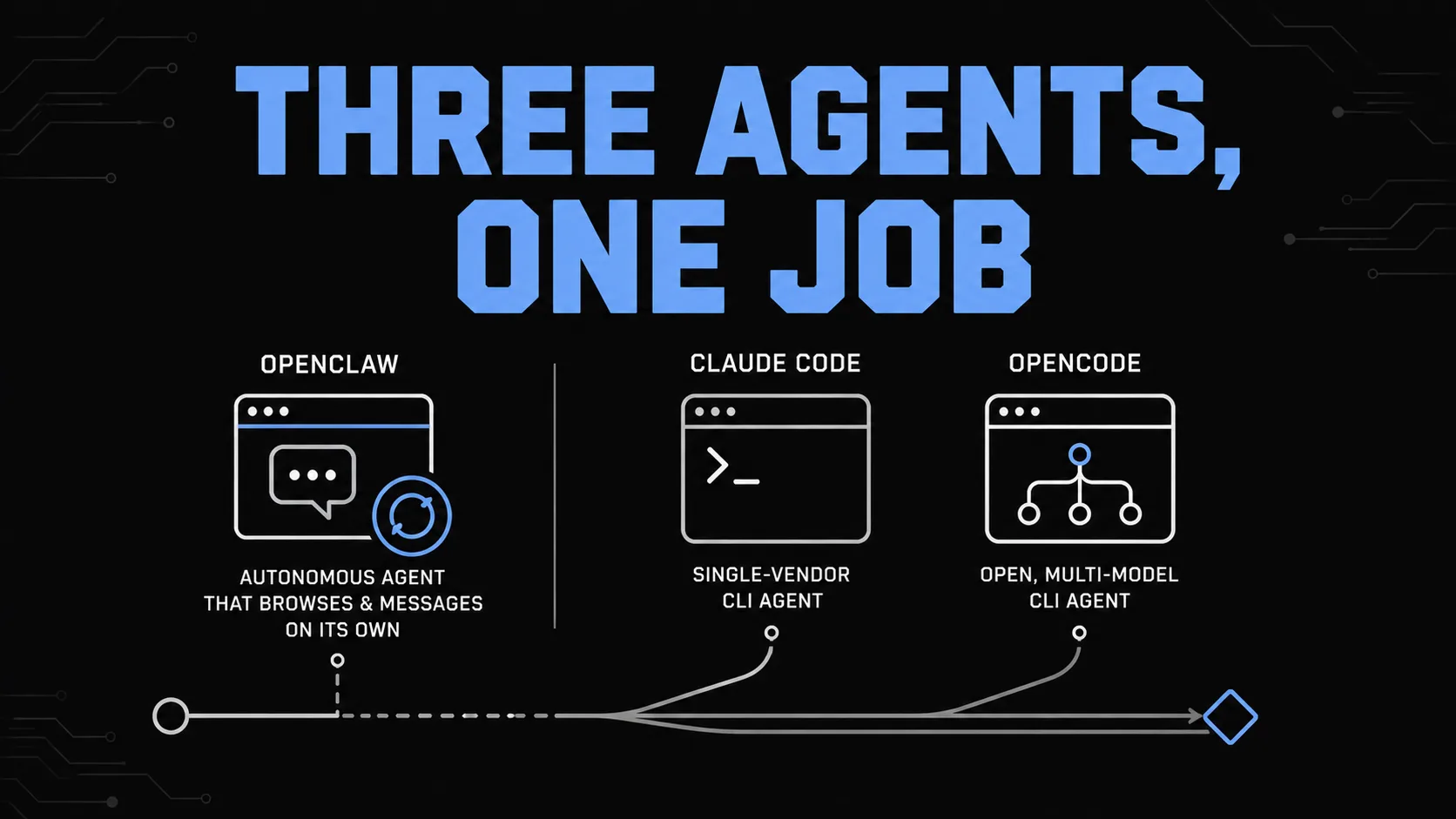
OpenClaw vs Claude Code vs OpenCode: Which Should Actually Run Your Workflow?
We have covered OpenClaw, Claude Code, and OpenCode separately on this blog, and each post gets its own steady stream of search traffic. What we have not done until now is put the three side by side, even though that is the question people actually type into Google once they have read one of those posts and started wondering about the other two.
The honest answer is that this is not a clean three-way fight. Two of these tools compete directly for the same job. The third is doing something different enough that comparing it head to head with the other two would be misleading.
Quick answer
If you are choosing a coding agent to run inside a terminal on a real repository, the decision is between Claude Code and OpenCode: Claude Code for a polished, single-vendor experience backed by Anthropic, OpenCode for open-source flexibility across more than 75 model providers and no subscription lock-in. OpenClaw is not really competing for that job at all. It is an autonomous background agent built for email, messaging, and browser automation that runs continuously without a developer at the keyboard, and it carries a meaningfully different security profile as a result. Most readers landing on this comparison actually want a coding agent, so start with Claude Code versus OpenCode, and only look at OpenClaw if what you need is unattended automation across your whole digital life, not code.
Three tools, two different jobs
The reason “OpenClaw vs Claude Code vs OpenCode” is a slightly odd question is that it groups a developer-invoked coding agent category with an autonomous background agent category, as if they were competing for the same use case. They are not.
Claude Code and OpenCode both live in the same category: you open a terminal, point the agent at a codebase, and it edits files, runs commands, and reports back within that session. Nothing happens unless you start it. OpenClaw is built to run in the background indefinitely, watching messaging apps, managing calendars, and executing scheduled tasks whether or not anyone is watching. That is a genuinely different product shape, not a feature gap.
We have written a full standalone guide to OpenClaw and to OpenCode, and a setup guide for running Claude Code against non-Anthropic models through Opencode Zen. This post exists to connect those three pieces and give a straight answer on which one fits which job.
What Claude Code actually is
Claude Code is Anthropic’s own command-line coding agent. It ships as a first-party CLI, is bundled into Claude’s subscription tiers (Pro at roughly $20 a month, Max 5x at roughly $100, Max 20x at roughly $200, plus Team and Enterprise seats), and it also works with a pay-per-token Anthropic API key if you would rather not subscribe. It runs exclusively on Anthropic’s own model lineup (Opus, Sonnet, and Haiku), which is exactly the trade-off you would expect from a vendor building a tool around its own models: strong integration, but no model choice.
Claude Code is invoked by a developer, works inside a specific project directory, and stops when the session ends. It reads and writes files, runs shell commands, and understands a codebase well enough to make multi-file changes without hand-holding.
What OpenCode actually is
OpenCode is a fully open-source, model-agnostic coding agent, built in Go by the team formerly known as SST (now operating as Anomaly). It passed 160,000 GitHub stars in 2026 and ships as a terminal TUI, a desktop app, and an IDE extension, with session data stored locally in SQLite rather than on a vendor’s servers.
The core difference from Claude Code is architectural, not cosmetic. OpenCode connects to more than 75 model providers, including Anthropic, OpenAI, Google, Bedrock, and local models through Ollama. The software itself is free; you only pay for whichever model you route requests to, and you can route to a free tier or a local model and pay nothing at all. We covered OpenCode’s architecture, its AGENTS.md project rules, and its GitHub workflow integration in detail in our dedicated OpenCode guide, so we will not repeat that setup material here.
What OpenClaw actually is
OpenClaw (formerly Clawdbot, then Moltbot) is an open-source autonomous agent, not a coding tool. It runs locally on your own hardware, connects through messaging platforms like WhatsApp, Telegram, Discord, and Signal as its user interface, and keeps persistent memory in plain-text files so it can act on your behalf across sessions rather than answering a single prompt and stopping. Its native use cases are inbox triage, calendar management, scheduled workflow automation, and browser-based tasks, not software development.
Nothing about that description involves reading a git repository or making pull requests as its primary function, which is why lining it up against Claude Code and OpenCode as if they solve the same problem produces a false equivalence. We go into OpenClaw’s full feature set, adoption numbers, and use cases in our original OpenClaw overview.
The autonomy and security gap
This is the part of the comparison that actually matters and where being honest costs OpenClaw some points.
Claude Code and OpenCode both operate inside a session a developer starts. Even with full shell access, the blast radius is bounded by when you are running the tool and what directory you pointed it at. OpenClaw is designed to do the opposite: it stays running, polls for tasks, and acts without a human confirming each step, which is exactly what makes it useful for background automation and exactly what makes it a different security category.
Security researchers have been specific about this. Sophos called OpenClaw’s rise a warning shot for enterprise AI security. CrowdStrike flagged prompt injection as a first-order threat given the tool’s broad permissions and “agentic blast radius.” Kaspersky’s audit found hundreds of issues in the skill ecosystem that lets community-built extensions run with elevated access, and independent scans found tens of thousands of misconfigured public instances leaking tokens. None of that is present in the same way for Claude Code or OpenCode, because neither one runs unattended with standing access to your email, calendar, and messaging apps.
That does not make OpenClaw a bad tool. It makes it a tool that needs to be treated like a production identity, not a chat window: sandboxed execution, least-privilege scopes, vetted skills only, and logged egress. We wrote a full hardening playbook, including the specific attack chains, incident response steps, and a copy-paste policy checklist, in our OpenClaw security deep dive. If you are considering OpenClaw for anything beyond a personal sandbox, read that post before you connect it to anything real.
Claude Code vs OpenCode: the actual head-to-head
Once OpenClaw is set aside as a different category, the real decision most developers face is Claude Code against OpenCode. Here is how they actually differ.
| Claude Code | OpenCode | |
|---|---|---|
| License | Proprietary, Anthropic | Open source (MIT) |
| Model access | Anthropic models only (Opus, Sonnet, Haiku) | 75+ providers, including local models via Ollama |
| Cost structure | Bundled subscription ($20 to $200/month) or API pay-per-token | Free software; pay only for the model you choose, including free-tier or local options |
| Hosting | Anthropic-hosted | Self-hosted, local-first, data stored on your machine |
| Interface | Terminal CLI | Terminal TUI, desktop app, IDE extension |
| Customization | Limited to Anthropic’s roadmap | Fully configurable, custom agents, self-hostable |
| Setup effort | Minimal | More upfront configuration |
Neither column is strictly better. Claude Code wins on simplicity: install it, subscribe or add an API key, and you are working with a well-integrated agent that Anthropic tunes specifically for its own models. OpenCode wins on flexibility and cost control: no vendor lock-in, the ability to switch models when pricing or performance shifts, and a path to running entirely on local models for teams that cannot send code to a third party.
There is also a middle path worth knowing about. Because Opencode Zen exposes an Anthropic-compatible endpoint, you can keep using Claude Code’s actual CLI and workflow while routing its requests through other models instead of paying for Claude Max. We walked through that exact setup, including the specific configuration file changes and how to find correct model identifiers, in our Opencode Zen setup guide. It is a reasonable way to get Claude Code’s polish without being fully locked into Anthropic’s pricing, though free models on a shared gateway come with their own availability and privacy trade-offs, which that post covers.
Pricing, honestly
Claude Code’s cost is straightforward because it rides on Claude’s own subscription tiers: Pro around $20 a month, Max 5x around $100, Max 20x around $200, plus Team seats and pay-per-token API access for anyone who would rather not subscribe at all.
OpenCode’s core software costs nothing. Your actual spend depends entirely on which models you point it at. Use a paid frontier model and you pay that provider’s token rates. Use a free tier, a discounted provider, or a local model through Ollama, and your marginal cost drops to zero, in exchange for whatever quality gap exists between that model and a frontier one.
OpenClaw is free and open source in the same sense OpenCode is, but “free” undersells the real cost. Running it safely means budgeting for isolated hosting, monitoring, and time spent vetting or disabling community skills, none of which shows up on a pricing page but all of which is real operational cost if you intend to give it meaningful access to your accounts.
Which one should actually run your workflow
If you write code for a living and want an agent working inside your terminal on a real project, and you are comfortable paying Anthropic directly for a tuned, low-friction experience, Claude Code is the sane default. It is the least amount of setup between you and a working agent.
If you want that same category of tool but need to switch models, keep code on your own infrastructure, or avoid a subscription entirely, OpenCode is the better fit, and it is mature enough now that the trade-off is mostly configuration time, not missing capability. Combining it with Claude Code’s own CLI through Opencode Zen is a legitimate middle option if you like Claude Code’s workflow but want out of Anthropic-only pricing.
If what you actually want is something that clears your inbox, reschedules meetings, and runs browser tasks while you are away from the keyboard, neither of the first two tools does that job at all, and OpenClaw is the one built for it. Just treat the autonomy as a security decision, not a convenience feature, and read the hardening playbook before you connect it to anything that matters.
Frequently asked questions
Is OpenClaw a replacement for Claude Code or OpenCode? No. OpenClaw is an autonomous background agent for messaging, scheduling, and browser automation, while Claude Code and OpenCode are developer-invoked coding agents that operate inside a terminal session. They solve different problems and can reasonably be used alongside each other rather than instead of each other.
Which is cheaper, Claude Code or OpenCode? OpenCode’s software is free, and your cost depends on which model provider you connect, including free or local options that cost nothing. Claude Code is bundled into Claude’s subscription plans, roughly $20 to $200 a month depending on tier, or billed per token through the API. For a developer already paying for Claude, Claude Code has no separate cost. For anyone unwilling to commit to Anthropic specifically, OpenCode is the cheaper starting point.
Can I use Claude Code with models other than Anthropic’s? Not natively. Claude Code is built around Anthropic’s own models. You can redirect its API calls through an Anthropic-compatible gateway like Opencode Zen to reach other models, which we cover in our setup guide, but that is a workaround rather than a supported multi-model feature.
Is OpenClaw safe to run? It can be, but not by default. OpenClaw’s autonomy and broad permissions have been flagged by multiple security researchers, and real incidents have involved malicious community skills and misconfigured public instances. Running it safely requires sandboxing, least-privilege scopes, and vetted skills, which we detail in our full security guide.
Do I need OpenCode’s multi-model support if I only use one AI provider anyway? Probably not immediately, but it is worth having as an option. Model pricing and capability shift often enough that being locked to a single vendor can become expensive or limiting later, even if it is not a problem today.
Which tool should a solo developer with a small budget start with? OpenCode, generally, because the software is free and you can start on a free or low-cost model tier while you decide whether the workflow suits you. If you already pay for a Claude subscription for other reasons, Claude Code is essentially included at no extra cost and is worth trying first.