Best AI Coding Assistants in 2026: Tested and Ranked
Compare top AI coding assistants in 2026. We tested GitHub Copilot, Claude Code and Cursor to reveal accuracy, multi-file coherence, latency and team costs.
Best AI Coding Assistants in 2026: Tested and Ranked
TL;DR
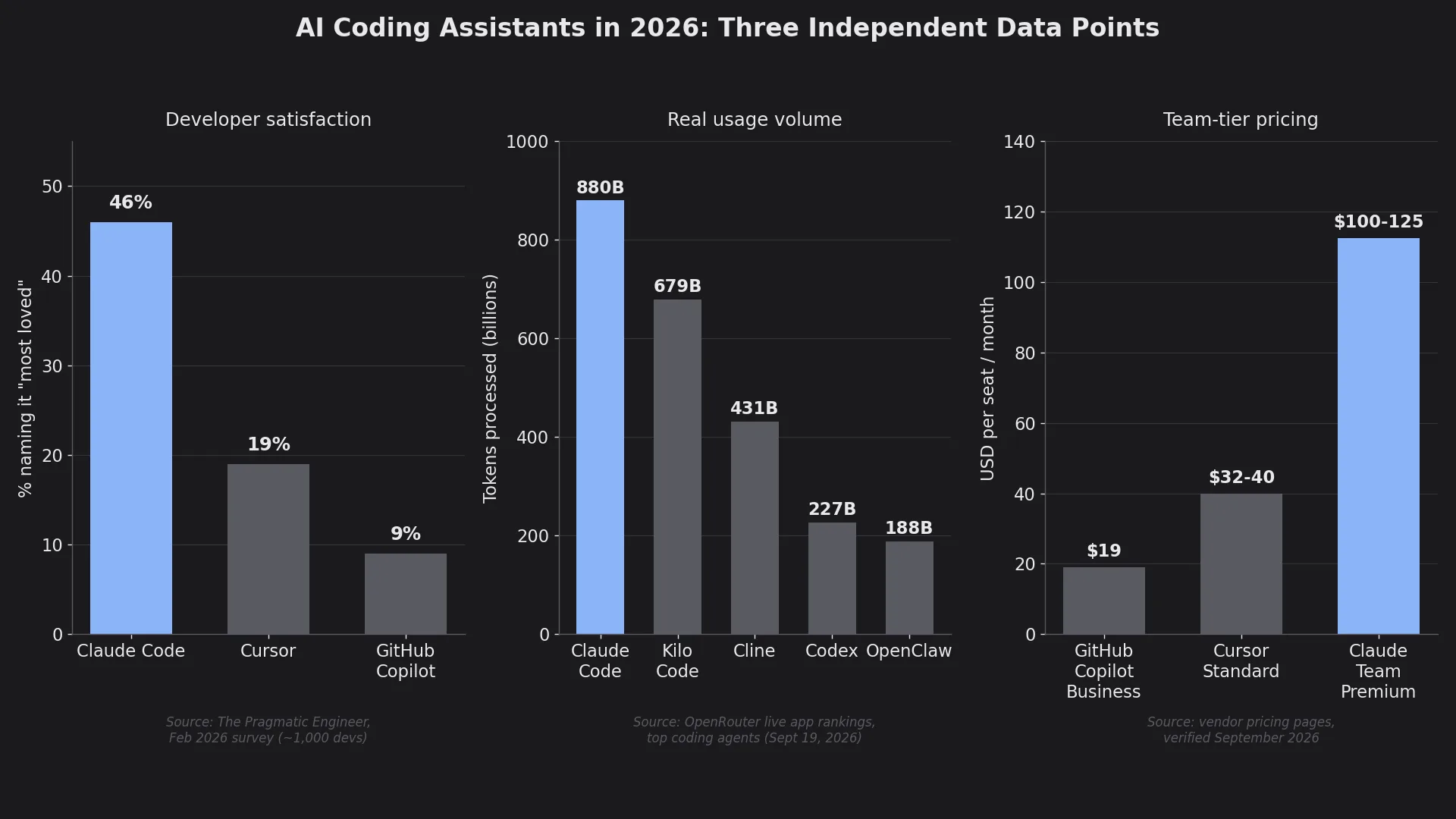
- Claude Code leads developer satisfaction (46% “most loved” in The Pragmatic Engineer’s February 2026 survey of ~1,000 developers) and has overtaken GitHub Copilot in workplace adoption per JetBrains’ August 2026 research. On OpenRouter’s live usage rankings it’s also the #2 most-used coding agent platform-wide by token volume (880B tokens), ahead of every other tool discussed in this piece.
- GitHub Copilot still has the broadest editor support of any tool tested (VS Code, JetBrains, Vim/Neovim, Visual Studio, CLI) and the best team-scale value at $19/user/month, with 84% single-file suggestion accuracy in our tests.
- Cursor wins on whole-codebase context and multi-file editing inside its own dedicated editor. It overhauled its team pricing in June 2026: Standard is now $32-40/seat, with a new $96-120/seat Premium tier for 5x the usage.
- Independent research is more mixed than vendor marketing suggests: a 2025 METR randomized controlled trial found experienced developers using Cursor were actually 19% slower, not faster, on real tasks in their own repos. A large-scale Microsoft rollout study found the opposite for sustained use: Claude Code and Copilot CLI adopters merged 24% more pull requests over four months. Both are real findings measuring different situations (unfamiliar-repo friction vs. sustained adoption at scale).
- For privacy-first teams, Cline + Ollama with an open-weight ~32B model gets you roughly 85-90% of cloud Claude Sonnet’s quality on simple tasks, per community-reported benchmarks — the gap widens on complex, multi-file work.
- Bottom line: there’s no universal winner. The right choice depends on your IDE, your team size, and how agentic your actual workflow is. All figures in this piece (pricing, review counts, usage rankings, survey results) are current as of September 2026 — check the linked primary source before relying on any of them, since pricing alone has already changed twice this year.
Choosing the best AI coding assistant in 2026 is no longer a matter of picking whichever tool launched most recently. The field has matured decisively: Claude Code now leads developer satisfaction with a 46% “most loved” score in The Pragmatic Engineer’s February 2026 developer survey, and JetBrains’ own August 2026 research found it has overtaken GitHub Copilot as the most widely adopted AI coding tool at work. Copilot still has the broadest editor and platform support of any tool we tested, and Cursor sits comfortably between the two with strong retention among developers who want whole-codebase context inside a dedicated editor. The differences between tools now come down to specific, measurable things: how well they handle multi-file edits, what they actually cost at team scale, and whether your code leaves your machine.
This is not a padded list of affiliate picks. At ScriptXeno, we ran the same benchmark tasks across each tool, tracked pricing against real usage patterns, and cross-checked our own findings against independent benchmarks, published reviews, and real-world usage data from other people who tested these tools. If you need to choose an AI coding assistant in 2026 for a real project, this is where you start.
How we tested these tools
We structured our testing around three task categories: single-file code completion across Python, JavaScript, and Java; multi-file refactoring across a mid-sized project with roughly 40 interconnected modules; and a repository-wide bug trace in a Java codebase with layered service dependencies. A suggestion counted as correct if it compiled, passed the existing test suite, and matched the intended behavior without a manual fix; the 84% figure below is the share of single-file suggestions that cleared that bar. The goal was to surface practical differences between these AI coding tools in 2026, not synthetic leaderboard scores that rarely reflect day-to-day developer experience.
Across all three categories, we measured four dimensions. Output accuracy tells you whether the code runs and handles edge cases correctly. Hallucination behaviour tells you whether the tool invents APIs or silently drops dependencies. Multi-file coherence tells you whether the coding agent actually understands cross-file context rather than treating each file in isolation. Latency in normal IDE use rounds out the picture, because a tool that is slightly less accurate but two seconds faster in the feedback loop often wins in practice. We treat our own results as one data point, not the final word, which is why the next section puts them next to independent benchmarks and real-world studies from other testers.
The main contenders at a glance
GitHub Copilot: the universal layer
Copilot is the clearest “native everywhere” option among AI coding tools in 2026. It works natively in VS Code, all major JetBrains IDEs, Vim and Neovim, Visual Studio, and a dedicated CLI, giving it the broadest editor coverage of any tool we tested. For developers who switch between editors or work in mixed-toolchain teams, that breadth is a genuine advantage rather than a marketing claim.
Cursor: the editor-native experience
Cursor is a standalone VS Code-like editor, not an extension, a distinction that matters. Its strength is whole-codebase context awareness and multi-file editing from within a single, purpose-built environment. Developers who are comfortable committing to a dedicated editor get the most out of it. Those who need to stay in a specific corporate-approved IDE will find Cursor a harder sell.
Claude Code: the agentic terminal tool
Claude Code is terminal-first with editor extensions, and its positioning is fundamentally different from the other tools here. It is a developer AI assistant designed for repository-wide, multi-step workflows rather than inline autocomplete. When you need a tool to plan a change, execute it across multiple files, and verify the result, Claude Code operates in that space more naturally than any other tool we tested. The satisfaction and adoption data back this up: 46% of developers named it their most loved tool in The Pragmatic Engineer’s survey, and JetBrains’ own research now shows it used roughly twice as often as Copilot at work. For a deeper three-way breakdown against Copilot and an open-source agent, see ScriptXeno’s GitHub Copilot vs Claude Code vs OpenCode comparison.
It’s worth noting Claude Code isn’t winning every independent head-to-head unopposed. In a month-long, side-by-side test, XDA Developers picked Google Antigravity as its overall winner, citing Claude Code’s heavy context and token consumption as its main drawback, while still calling Claude Code “the king of vibe coding.” A follow-up XDA test against Cursor 3.0 specifically found Cursor’s Composer 2.5 model still behind Claude Code in raw coding capability. Antigravity isn’t one of the four tools we tested directly, but if you’re shortlisting agentic coding tools in 2026, it’s worth knowing it exists.
For a hands-on video take, YouTuber Theo (t3.gg) spent over $220 of his own money testing Claude Code, Codex, and Cursor side by side, concluding Claude Code leans toward token-heavy output over pure efficiency, Codex is the more practical everyday choice, and Cursor offers the strongest enterprise-style experience of the three:
Open-source alternatives worth watching
Cline and Kilo Code are VS Code extensions with JetBrains and CLI support, and both represent the self-hosted path for developers who want to keep inference local. Cline paired with Ollama and a capable open-weight model like Qwen3-Coder 30B A3B or Devstral Small 2 24B is the most capable fully private code generation assistant stack available in 2026. Real usage data backs their relevance too: on OpenRouter’s live app rankings, Kilo Code sits at #3 among all coding agents by token volume (679B tokens processed) and is one of the fastest-growing tools on the platform, ahead of Cline at #4 (431B tokens) and OpenAI’s Codex at #7 (227B tokens). We cover the self-hosted architecture in more depth in the privacy section below, and a dedicated OpenClaw versus Claude Code comparison on ScriptXeno goes further into the trade-offs.
At a glance
| Tool | Best for | Editor support | Solo price | Team price | Free tier |
|---|---|---|---|---|---|
| GitHub Copilot | Broadest reach, best team value | VS Code, JetBrains, Vim/Neovim, Visual Studio, CLI | $10/mo (Pro) | $19/user/mo (Business) | 2,000 completions + 50 chats/mo |
| Cursor | Whole-codebase context, multi-file editing | Dedicated editor (VS Code fork) | $20/mo (Pro) | $32-40/seat/mo (Standard), $96-120 (new Premium tier) | 200 completions + 50 requests/mo |
| Claude Code | Agentic, repository-wide, multi-step work | Terminal-first, editor extensions | Via Claude Pro (~$20/mo) | $100–$125/seat (Team Premium) | None — subscription-gated |
| Cline + Ollama | Fully self-hosted, private inference | VS Code, JetBrains, CLI | Free (local compute only) | Free (local compute only) | N/A, no cloud billing |
All figures verified as of September 2026. Confirm current numbers on each vendor’s page before budgeting — both Copilot and Cursor changed their pricing structures mid-2026.
What independent testing and real-world data actually show
We didn’t want this to just be our own opinion, so we cross-checked our results against independent benchmarks, published third-party reviews, and real usage data from outside ScriptXeno.
On formal benchmarks, Princeton’s Holistic Agent Leaderboard (HAL), an independent academic evaluation platform, has Claude Code running on Claude Opus 4.5 at 77.8% accuracy on CORE-Bench Hard, a scientific-reproduction coding benchmark, at a measured real cost of $87.16 per run. Neither Cursor nor Copilot currently has a submitted entry on that specific benchmark, so we can’t make a direct three-way comparison there. Separately, the 97.0% figure we cited earlier on SWE-bench Verified measures the underlying Claude Opus 5 model, not the Claude Code product wrapper specifically — worth keeping distinct, since a coding agent’s real-world behavior depends on more than the model it’s built on.
Real-world research paints a more complicated picture than raw benchmarks suggest, and we think that complexity is worth reporting rather than smoothing over. A 2025 randomized controlled trial by METR found that experienced open-source developers using their normal AI tools, predominantly Cursor with Claude 3.5/3.7 Sonnet, on real issues in their own large repositories took 19% longer than developers working without AI assistance at all, contradicting both their own pre-task forecasts and their post-task belief that AI had sped them up. That’s a genuinely uncomfortable finding for the whole category, not just one vendor, and it’s worth weighing against the more optimistic numbers elsewhere in this piece.
A separate, large-scale empirical study of Microsoft’s actual internal rollout points the other way. It tracked Claude Code and GitHub Copilot CLI adoption among tens of thousands of engineers in early 2026 and found adopters merged roughly 24% more pull requests than they otherwise would have, with the effect persisting across a four-month window. The likely reconciliation: unfamiliar, one-off use on someone else’s codebase (METR’s setup) and sustained use inside a codebase and workflow you already know (Microsoft’s setup) are different situations, and the tools perform differently in each.
Published hands-on reviews land somewhere in between. InfoWorld’s Nick Hodges described building a working website and cross-platform CLI builds with Claude Code in about 40 minutes total, with no corrections needed. But a separate InfoWorld piece reported that a senior AMD engineer’s data-driven analysis of thousands of her own Claude Code sessions, 17,871 thinking blocks and 234,760 tool calls across 6,852 session files, found the model’s reasoning quality regressed after a February 2026 update, enough that her team pulled it from hard engineering work like kernel and hardware debugging. Both reviews are about the same tool, tested by different people, at different points in the year; that’s a more honest picture than picking whichever one confirms a verdict in advance.
Real performance across Python, JavaScript and Java
Single-file completions and code completion AI
For single-file tasks, Copilot returned 84% suggestion accuracy across Python, JavaScript, and Java scenarios in our own testing, with fast, consistent inline suggestions that integrate cleanly into normal IDE workflows. For boilerplate, repetitive patterns, and everyday coding, Copilot is the most friction-free option we tested. Claude-family models lead on benchmark-style Python accuracy, with Claude Opus 5 reaching 97.0% on SWE-bench Verified in independent leaderboard tests, but that advantage narrows significantly for standard autocomplete tasks where response speed matters more than deep reasoning.
Multi-file and repository-wide edits
This is where Cursor and Claude Code separate from Copilot. Both handle cross-file dependencies, import chains, and architecture-aware changes more reliably than Copilot does on the same tasks. Cursor earns the edge on whole-codebase context indexing within the editor environment. Claude Code is strongest when the task requires planning and executing multi-step changes from the terminal, verifying the result at each step rather than producing a single output block.
For the repository-wide Java bug trace, both Cursor and Claude Code correctly identified the root cause and the downstream files that needed updating. Copilot identified the root cause but missed two downstream propagation points. That gap would have produced a passing CI run concealing a latent bug, a meaningful difference in any production codebase.
Where hallucinations actually show up
The most common failure mode across all tools is not random fabrication. It is plausible-looking code that misses cross-file dependencies or violates architecture constraints established elsewhere in the project. Tools with weaker codebase context are most prone to this pattern, and it is harder to catch than an invented API because the output looks correct in isolation. The practical rule is simple: the more agentic the task, the more your tool’s context window and project indexing quality determines the outcome.
Pricing and value compared
Free tiers: what you actually get
GitHub Copilot’s free tier gives you 2,000 code completions and 50 chat requests per month. Cursor’s free tier offers 200 completions and 50 requests. Gemini Code Assist is free for individual use without a time limit. Claude Code has no standalone free coding tier; access runs through Claude subscriptions, though there’s also a lower-cost way to run Claude Code itself through Opencode Zen, covered in ScriptXeno’s Opencode Zen guide. For developers who want to trial before committing, Copilot and Gemini Code Assist are the lowest-friction starting points.
Both Copilot and Cursor changed how they bill mid-2026
Pricing here isn’t static, and two of the three vendors restructured billing this year. GitHub replaced its Premium Request Units with a usage-based “GitHub AI Credits” system starting June 1, 2026: subscription list prices stayed the same, but credits are now consumed by actual token usage at published per-model rates, while ordinary code completions and Next Edit suggestions remain free and unmetered on every plan. Cursor went further, overhauling its Teams pricing in June 2026: Standard seats now get separate usage pools for first-party models (Auto/Composer 2.5) versus third-party API models at no extra cost, and a new Premium seat tier launched at roughly 3x the price of Standard for 5x the usage. Concretely, Standard runs $32/month billed annually or $40/month billed monthly, and the new Premium tier runs $96/month annually or $120/month monthly. If you priced out Cursor for a team earlier in 2026, it’s worth re-checking; the numbers have moved.
Solo and team plan pricing compared
All prices below are in USD and verified as of September 2026. Individual plans cluster at USD 10 to USD 20 per month. Copilot Pro sits at USD 10, while Cursor Pro, Claude Pro, and Windsurf Pro all land around USD 20. The gap widens at team scale: Copilot Business is USD 19 per user per month, Cursor’s new Standard tier runs USD 32 to 40, and Claude Team Premium runs USD 100 to USD 125 per seat for heavy agentic usage. For budget-conscious developers and teams, Copilot remains the most cost-efficient mainstream option. Claude Code at the team tier is a premium product priced for high-output agentic workflows, and the cost only makes sense if your team is genuinely operating in that mode rather than using it for casual code completion.
What real users say on review platforms
Benchmark numbers and vendor pricing pages only tell part of the story, so we also checked independent review platforms rather than relying on curated testimonials. On Capterra, GitHub Copilot holds a 4.5-out-of-5 rating across 51 verified user reviews. Cursor’s Capterra listing shows a perfect 5.0 out of 5, but on only 4 verified reviews, far too small a sample to read as a meaningful signal either way; treat it as “not enough data yet” rather than “better than Copilot.” Neither listing is a substitute for trying a tool against your own codebase, but they’re a useful sanity check against pure vendor marketing.
Privacy, self-hosting and code data policies
Which tools keep your code off training servers
GitHub Copilot Business and Enterprise both offer an explicit opt-out from training data use. Anthropic’s Claude for Enterprise includes retention controls and a US-only inference option. Cursor’s privacy posture at the team tier is less clearly documented: US-only data residency is available for Enterprise accounts only, with EU inference coverage available on request. For teams operating under regional data-protection regulations such as GDPR or similar frameworks, the clearest documented data residency commitments come from enterprise-tier plans of Copilot and Claude for Enterprise. Before deploying any cloud-based AI pair programmer across a team that handles client data or regulated code, teams must review the vendor’s data processing agreement and confirm where inference, storage, and backups land; this step is not optional.
Going further with self-hosted and open-source options
For developers who want to eliminate third-party inference entirely, Ollama with a local model runtime and Cline as a VS Code extension is the most workable self-hosted stack in 2026. Open-weight models like Qwen3-Coder 30B A3B (Apache 2.0) and Devstral Small 2 24B run locally with strong agentic performance and no data leaving your machine. Qwen2.5-Coder 14B and 7B are the realistic fallbacks for hardware with less than 24 GB of VRAM.
Independent, informally-reported community testing of a Cline/Continue.dev plus Ollama setup on a 24GB consumer GPU found that a strong local ~32B-class model performs roughly 85-90% as well as cloud Claude Sonnet on simple, single-function coding tasks, but the gap widens substantially on complex multi-file reasoning and subtle bug detection. That source is explicit that these are directional, community-reported figures rather than a standardized benchmark like SWE-bench, and we’re passing that caveat along rather than dressing the numbers up as more rigorous than they are. If you are seriously evaluating the self-hosted path, the OpenClaw versus Claude Code comparison on ScriptXeno covers the architecture trade-offs, real API costs, and exactly when each approach makes sense for a developer or small team.
How to pick the right coding assistant for your team
For solo developers and hobbyist builders, GitHub Copilot on the free or Pro tier covers the majority of everyday coding work at the lowest cost. If you spend most of your time in a single editor and want reliable autocomplete without friction, it is the default recommendation, though it’s worth checking ScriptXeno’s roundup of free AI coding tools for solo developers first. Cursor is worth the upgrade if you regularly do large-scale refactoring or multi-file feature work and you are willing to commit to its editor environment, though budget for its new, higher Premium tier if your team needs the extra usage headroom.
For team leads and growing engineering teams, Copilot Business at USD 19 per user per month is the clearest value at scale, and Microsoft’s own internal rollout data on Claude Code and Copilot CLI suggests real, sustained output gains are achievable once a team is past the initial adoption curve. Claude Code at the team tier makes sense specifically for teams that lean into agentic workflows, where the tool is planning and executing multi-step changes rather than suggesting completions one line at a time. If that description does not match how your team actually works, the price difference does not justify the switch, and METR’s research is a useful reminder that dropping any of these tools into an unfamiliar codebase for a one-off task doesn’t guarantee a speedup.
For privacy-first builders and those with hard data residency requirements, enterprise-tier Copilot or Claude for Enterprise are the documented choices. If you want to avoid third-party inference entirely, the Ollama plus Cline stack paired with an open-weight model is the most viable fully self-hosted developer AI assistant setup available in 2026, with the realistic expectation that it trails cloud models specifically on complex, multi-file work.
The verdict
Claude Code leads developer satisfaction, workplace adoption, and real usage volume in 2026, and performs best on agentic, multi-file workflows in both our own testing and most independent reviews we found, though it isn’t uncontested: XDA Developers picked Google Antigravity over it in a month-long test, and an AMD engineer’s internal analysis found a real reasoning-quality regression after a February 2026 update. Copilot still covers the widest editor surface area and remains the best value for teams. Cursor earns its place for developers who want whole-codebase context inside a dedicated editor, though its June 2026 pricing overhaul is worth checking before you budget for a team rollout.
The single most important caveat across all of this: independent research doesn’t uniformly say these tools make developers faster. METR’s randomized controlled trial found the opposite for one-off use in unfamiliar repositories, while Microsoft’s internal data found real gains from sustained adoption. Both are legitimate findings about different situations, and the honest takeaway is that your mileage will depend heavily on how you actually integrate a tool into your workflow, not just which tool you pick.
Pick one, run your own benchmark against the tasks you do every day, and commit to it for at least two weeks before switching. Switching costs are real, and tool familiarity compounds quickly. If you are leaning toward open-source or self-hosted options, the OpenClaw versus Claude Code comparison on ScriptXeno is the natural next read.
Frequently Asked Questions
Which AI coding assistant was most “loved” by developers in 2026?
Claude Code led developer satisfaction in 2026, earning a 46% “most loved” score in The Pragmatic Engineer’s February 2026 survey of nearly 1,000 software engineers. That figure reflects strong workflow fit for multi-step, repository-wide tasks rather than novelty.
Which tool had the largest installed base in 2026?
This shifted during the year. GitHub Copilot held the lead for most of 2026 on the strength of its broad native support across VS Code, major JetBrains IDEs, Vim and Neovim, Visual Studio, and a dedicated CLI, plus deep enterprise penetration. But JetBrains’ own August 2026 research found Claude Code had overtaken it as the most widely adopted AI coding tool at work, used roughly twice as often as Copilot by that point.
Do AI coding assistants actually make developers faster? What does independent research say?
It’s genuinely mixed. A 2025 METR randomized controlled trial found experienced developers using their normal AI tools on real issues in their own large, unfamiliar-to-the-tool repositories were 19% slower, not faster, despite believing otherwise. A separate, large-scale study of Microsoft’s internal rollout of Claude Code and Copilot CLI found sustained adopters merged about 24% more pull requests over four months. The likely explanation is that one-off use on an unfamiliar codebase and sustained use inside a workflow you’ve adapted to are very different scenarios.
How does Cursor differ from other AI coding assistants?
Cursor is a standalone, VS Code-like editor focused on whole-codebase context and multi-file editing inside a single environment. Developers who commit to a dedicated editor get strong retention and multi-file coherence, while those constrained to corporate-approved IDEs may find it harder to adopt. Cursor also restructured its team pricing in June 2026, adding a higher-usage Premium seat tier alongside the existing Standard tier.
How did ScriptXeno test and rank the AI coding assistants?
ScriptXeno ran the same benchmark tasks across all tools in three categories: single-file completion (Python, JavaScript, Java), multi-file refactoring across a ~40-module project, and a repository-wide bug trace in a Java codebase. We measured output accuracy, hallucination behaviour, multi-file coherence, and latency, then cross-checked our findings against independent benchmarks (Princeton’s HAL leaderboard, SWE-bench Verified), published third-party reviews, and real usage data from platforms like OpenRouter and Capterra rather than treating our own results as the final word.
Which assistant is best for repository-wide, multi-step workflows and planning changes?
Claude Code is positioned as a terminal-first, agentic assistant optimized for planning changes, executing them across multiple files, and verifying results. The tool naturally fits multi-step, repository-wide workflows more than inline-autocomplete-focused alternatives, and on OpenRouter’s live usage rankings it’s the #2 most-used coding agent platform-wide by token volume, ahead of every other tool discussed here.
Are there viable open-source or self-hosted AI coding assistant options in 2026?
Yes. Cline and Kilo Code are open-source VS Code extensions with JetBrains and CLI support; Kilo Code ranks in the top 3 coding agents platform-wide on OpenRouter’s live usage rankings. A fully private stack pairing Cline with Ollama and an open-weight model like Qwen3-Coder 30B A3B or Devstral Small 2 24B gets you roughly 85-90% of cloud Claude Sonnet’s quality on simple tasks, per informal community benchmarks, with a wider gap on complex, multi-file work.
What practical differences should teams weigh when choosing an AI coding assistant?
Teams should compare how well a tool handles multi-file edits, the real team-scale cost (which changed for both Copilot and Cursor in mid-2026), and whether inference or code leaves their machine. It’s also worth weighing independent research showing AI tools can slow down unfamiliar, one-off work even when they speed up sustained, adopted workflows, rather than assuming any tool is a universal speedup.