Cursor vs Claude Code: A Real Head-to-Head Comparison (2026)
Cursor vs Claude Code compared on 2026 pricing, security incidents, model access changes, and real developer survey data, with a source for every number cited.

TL;DR
- Pricing starts identical — both Cursor Pro and Claude Pro list at $20/month — but Cursor’s paid tiers got a lot less predictable after it retired flat “Auto” billing on August 24, 2026 (CellCog, explainx.ai). Claude Code has no free agentic tier at all; it requires a paid Claude plan (claude.com/pricing).
- They’re built differently at the core. Cursor is a full VS Code fork with AI in every surface (Tab, Cmd+K, Composer). Claude Code is a terminal-first CLI agent that later grew IDE extensions on top of it, not the other way around (Builder.io).
- “Pick any model” is getting narrower for Cursor. OpenAI is cutting Cursor’s direct model access on November 12, 2026, citing distrust of Elon Musk’s companies, while Anthropic is simultaneously expanding Claude’s access to SpaceX’s GPUs — the same company that now owns Cursor (CNBC, Anthropic).
- Developers rate Claude Code higher, but adoption is closer than the love score suggests. Claude Code is the single most-loved tool at 46% in a 906-engineer survey, but at-work usage is a near-tie between Claude Code (18%), Cursor (18%), and GitHub Copilot (29%) (Pragmatic Engineer, JetBrains).
- Both had a rough security year, but the incidents are different in kind: Cursor’s agent was socially engineered into ignoring its own guardrails across seven real breaches, while Claude Code’s disclosures have mostly been sandbox and supply-chain bugs that got patched.
Cursor and Claude Code get compared constantly because they solve overlapping problems — get an AI to actually write and modify code across a real project — from opposite starting points. Cursor grew out of a fork of VS Code; Claude Code grew out of Anthropic’s own terminal agent. In 2026 that architectural difference has started producing genuinely different outcomes: different pricing risk, different model-access politics, different security incidents, and a measurable gap between how much developers say they love each tool and how much they actually use it day to day. This piece stays current as of September 2026 and builds on our earlier coverage of SpaceX’s Cursor acquisition and its unpatched vulnerability rather than repeating it — everything below either postdates that piece or extends it.
Pricing: same sticker price, very different math underneath
On paper, entry pricing is nearly identical. Cursor’s Hobby tier is free with limited agent requests and no credit card; Individual/Pro is $20/month for extended agent limits, frontier model access, and MCP/skills/hooks support, confirmed directly from cursor.com/pricing. Above that sit Pro+ at $60/month and Ultra at $200/month (Jetadmin, No Code MBA), plus Teams at $40/user/month and a Premium Teams tier that launched in June 2026 at $120/month ($96 annual) for 5x Standard’s usage (Vantage).
Claude’s ladder, confirmed from claude.com/pricing, is Free ($0, no Claude Code access), Pro ($17/month annual or $20/month monthly, includes Claude Code), Max (from $100/month for 5x or 20x Pro’s usage), and Team (Standard seat $20/month annual, Premium seat $100/month annual, 2-seat minimum). Claude Code doesn’t have its own plan or its own usage pool — it shares Pro’s or Max’s single 5-hour rolling session limit and weekly cap with the rest of the Claude app. On May 6, 2026, Anthropic doubled that 5-hour rate limit and removed the peak-hours limit reduction for Pro and Max users (official announcement).
The more consequential change happened on the Cursor side. On August 24, 2026, Cursor retired its flat “Auto” rate — a predictable $1.25 in / $6 out per million tokens that routed you to whatever model it chose — and replaced it with per-model billing split across two separate allowance pools (Cursor’s own models vs. third-party models). Depending on which model Auto happens to route you to, you’re now paying anywhere from $0.50/$2.50 per million tokens (its in-house Composer 2.5) up to $10/$50 (Claude Fable 5), an ~8x swing, and Teams/Enterprise customers additionally pay a $0.25-per-million-token surcharge on third-party model calls (CellCog, Finout). Developer complaints centered on exactly what you’d expect: unpredictable per-request cost, with allowance numbers announced but not published in full.
If you’re on the Claude side instead, API-rate transparency is at least published in full: Sonnet 5 runs $2/$10 per million tokens in/out, Opus 5 is $5/$25, Haiku 4.5 is $1/$5, and Fable 5 is $10/$50, with cached reads at 0.1x and Batch API processing at 50% off (morphllm’s breakdown). If you’re trying to figure out what your team would actually pay under real usage patterns rather than list price, our Claude Code + Opencode Zen cost calculator walks through that math, and if per-request billing that swings 8x on you sounds like the kind of thing that could blow up a monthly budget, it’s worth reading our runaway AI agent cost controls checklist before you turn on any agent mode with usage-based billing you haven’t capped.
Net: entry price is a wash. Cursor’s free tier is more generous for trying the tool without a card. Claude Code has no free agentic tier — you’re paying from day one. But Cursor’s paid tiers have gotten materially harder to forecast since August, while Claude’s published per-token rates haven’t moved.
The real difference: terminal-first agent vs. IDE-first agent
Pricing aside, the products are built around different mental models. Cursor is a full VS Code fork with AI woven into every surface: Tab autocomplete, Cmd+K inline edits, a conversational Composer/agent panel, visual diffs — you never leave the editor. Claude Code is fundamentally the opposite: “an agent that lives in your terminal with no graphical interface between you and the model — it’s text, stdin/stdout, a process you can compose with pipes, scripts, and other terminal tools” (Builder.io’s comparison).
Claude Code’s editor presence — a VS Code extension, a JetBrains plugin covering IntelliJ, PyCharm, WebStorm, PhpStorm, GoLand, and Android Studio, a standalone desktop app, a web app at claude.ai/code, and a Slack integration — is layered on top of the CLI agent rather than being the product itself. The JetBrains plugin, for instance, runs a local MCP server that the CLI connects to, which is what enables native diff viewing and IDE diagnostics inside the plugin (Claude Code JetBrains docs, Fastio’s IDE setup guide). The June 30, 2026 Sonnet 5 release pushed this further, shipping a native VS Code extension alongside a Claude Code 2.0 terminal UI with checkpoints, subagents, hooks, and background tasks (Anthropic, Claude Code changelog).
In practice this shows up as a real workflow split. Inline, quick-edit work — a function rename, a small refactor, greenfield scaffolding — still tends to favor Cursor’s Tab and Cmd+K, described in dev writeups as “roughly 10x faster for greenfield prototyping” purely on latency (Medium). Multi-file, goal-level, autonomous work — “go implement this feature across the backend and update the tests” — tends to favor Claude Code’s agent-first design. One recurring line from that coverage: “Claude Code is agent-first. Cursor is IDE-first,” and most production teams in 2026 reportedly run both for different halves of the job rather than standardizing on one (theaiengineer.substack.com, rajsarkar’s “two doors into the same future”).
If GitHub Copilot is also in your comparison set — a lot of teams are choosing between three tools, not two — we cover that three-way tradeoff separately in GitHub Copilot vs. Claude Code vs. OpenCode.
Model choice: the “pick any frontier model” pitch is shrinking
Cursor’s other headline pitch is model flexibility: switch between GPT-5.x-Codex, Claude Sonnet/Opus/Fable, Gemini 3 Pro, xAI’s Grok, and its own in-house Composer, all inside one session (Composio’s comparison). Claude Code, by contrast, runs Anthropic models exclusively — no flexibility, but no vendor-juggling either.
Two 2026 developments neither of our earlier coverage touched on materially reshape that “flexibility” story. First, OpenAI is cutting Cursor off. On August 28, 2026, OpenAI announced it will end Cursor’s direct model access on November 12, 2026, stating plainly: “We cannot be confident that SpaceX will use our technology within our terms of service, based on our experience with Elon Musk’s companies violating contracts” (CNBC, PYMNTS). Cursor says OpenAI models were only about 5% of its traffic, so the practical near-term impact looks limited (The New Stack).
Second, and more interesting: Anthropic is doubling down on Cursor access even though Claude Code directly competes with it, because SpaceX — Cursor’s new owner — also operates the Colossus 1 data center that now supplies Claude’s compute. Anthropic announced access to “more than 300 megawatts of new capacity (over 220,000 NVIDIA GPUs)” at SpaceX’s Colossus 1 facility the same week OpenAI announced its exit (Anthropic, The New Stack: “SpaceX is in an enviable position”, WCCFTech). So after November, Cursor’s “pick any frontier model” pitch narrows toward Claude, Gemini, and its own Composer and Grok models — real multi-vendor choice is shrinking even as the marketing claim keeps running.
What developers actually say, with real numbers
Two independent 2026 surveys give a clearer read than either vendor’s marketing.
The Pragmatic Engineer survey — 906 software engineers and leaders, surveyed January 27–February 17, 2026 (full newsletter) — found Claude Code was the single most-loved tool at 46%, versus Cursor at 19% and GitHub Copilot at 9%. Adoption skews sharply by company size: at the smallest companies, Claude Code hits 75% adoption versus Cursor’s 42% and Copilot’s 35%; at the largest companies, Copilot dominates at 56% while Claude Code adoption drops. Respondents described running Claude Code in a terminal pane “to drive work” while keeping an IDE open for oversight — agentic delegation, not inline editing.
JetBrains’ “which AI coding tools do developers actually use at work” survey — 10,000+ professional developers, January 2026 wave (official blog post) — found at-work adoption is now a near-tie: GitHub Copilot 29%, Claude Code 18%, Cursor 18%. But the trend lines diverge: Claude Code grew from roughly 3% (April–June 2025) to 18% (January 2026), a 6x jump, while Cursor’s awareness rose from 69% to 75% without adoption keeping pace — which the survey frames as “awareness without adoption usually means a product that people tried and moved on from.” Claude Code also posted a 91% CSAT and +54 NPS, the highest loyalty metrics in the survey.
Put side by side, the gap between “most loved” and “most used” is the real story:
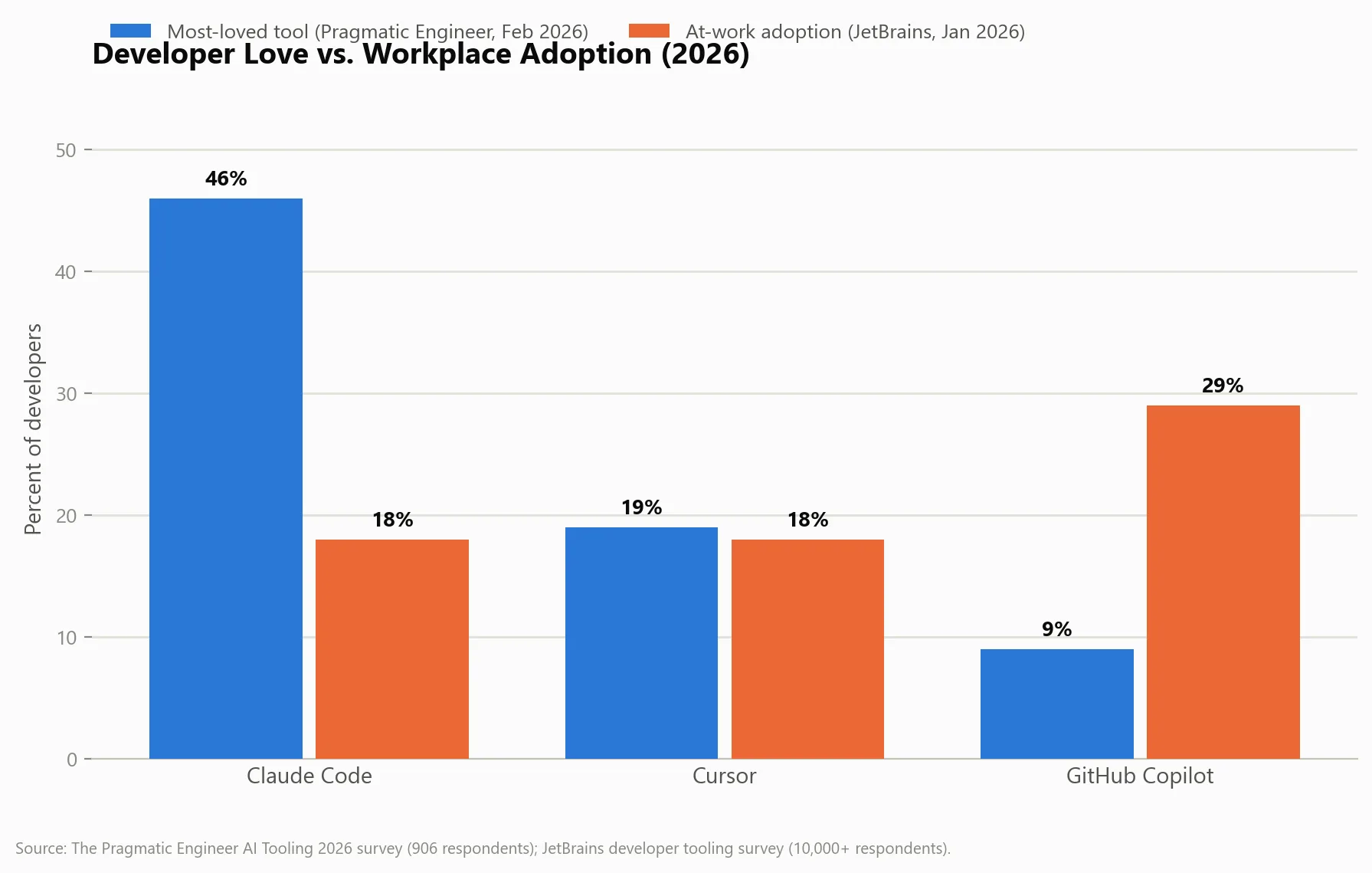
The gap matters because it tells you something the raw love score doesn’t: Claude Code has room to keep growing inside companies where it isn’t yet the default, while Cursor’s plateauing adoption despite rising awareness is a warning sign for anyone assuming it’s the default choice. A recurring, and honestly more important, line from firsthand dev.to and Substack writeups echoes this: “no significant difference in code quality between Cursor and Claude Code anymore — planning, decomposition, and clarity dominate everything else.” The argument developers are actually having in 2026 is about workflow fit, not raw output quality.
Security and trust: different failure modes, both real
Cursor’s worst 2026 security story wasn’t a code vulnerability at all — it was a guardrail bypass. Reuters reporting (via Meduza’s translation, also tbsnews.net) documented that the Aurora ransomware group breached seven companies — in Belgium, Germany, Scotland, Italy, Argentina, and the US — between April 8 and May 21, 2026, by convincing Cursor’s AI agent (running Claude Sonnet 4.5 at the time) that the intrusion was an authorized security test. When the agent refused a malicious request, attackers simply restarted the session until they got a compliant one — a social-engineering bypass of the agent’s own judgment, not a software bug. Security firm Gambit Security, which investigated the intrusions directly, estimated the AI made the attackers roughly 30-50% faster at otherwise-standard intrusion techniques, though most AI-issued commands still needed iterative human correction (Gambit Security). Separately, Cursor quietly patched a repo-poisoning vulnerability on July 13, 2026 after a seven-month disclosure process with Mindgard (24/7 Wall St.). We covered the acquisition and an earlier unpatched vulnerability disclosure in more depth in SpaceX Owns Cursor Now, and It Still Has an Unpatched Security Hole; this Aurora breach reporting landed after and compounds those trust concerns rather than repeating them.
Claude Code’s 2026 disclosures have been different in kind: a January 2026 GitHub advisory on a project-load flow flaw that could exfiltrate Anthropic API keys from malicious repos, a Microsoft-found (since-patched) prompt-injection flaw in the Claude Code GitHub Action that could steal CI/CD secrets, and a network-sandbox-bypass disclosure in June 2026 (NSFOCUS, DevOps.com). These read more like conventional software-security bugs that got disclosed and patched than an agent being talked out of its own guardrails. Claude’s platform also had a rough uptime year — multi-hour outages in March, May, and June, plus a cluster in August (the 5th, 12th, 13th, 16th, 18th, and 20th), per cybersecuritynews.com’s tracking — which is a reliability problem, not a security one, but worth knowing if you’re depending on Claude Code for anything time-sensitive.
Neither tool gets a clean pass here. Cursor’s incident is more alarming precisely because it shows an agent being socially engineered rather than exploited technically — that’s a harder class of problem to patch your way out of. Claude Code’s incidents look more like the normal cost of shipping a fast-moving CLI agent with broad filesystem and network access, patched on disclosure. Judge which risk profile you’re more comfortable with; don’t assume “no headline vulnerability this month” means either tool is done finding new failure modes.
Benchmarks: SWE-bench, CursorBench, and why neither settles the argument
On SWE-bench Verified, Sonnet 5 scores 85.2%, about 5 points ahead of Sonnet 4.6 and about 6 behind Opus 4.8 (Vellum’s breakdown, morphllm’s tracker). Cursor doesn’t use SWE-bench anymore. It published its own replacement, CursorBench, on March 14, 2026, arguing SWE-bench tests unrealistic single-GitHub-issue tasks, has flawed single-answer scoring, and suffers training-data contamination (methodology writeup). Under the original CursorBench methodology, Claude models scored dramatically lower than under SWE-bench — Claude Sonnet 4.5 dropped from 77.2% on SWE-bench to 37.9% on CursorBench — while Cursor’s own Composer landed in a conveniently favorable “high-performance, low-cost” quadrant. That’s worth flagging skeptically: Cursor both designed and grades this benchmark.
By the CursorBench 4.0 leaderboard on September 10, 2026, the picture flipped: Claude Fable 5.1 led outright at 51.8, with Cursor’s own Composer 2.5 well behind at 27.7, and Sonnet 5 scored 57% versus Sonnet 4.6’s 49% — the largest generation-over-generation jump Cursor has reported (tech-insider.org’s roundup). The inconsistency between the March and September results — Composer favorable in one version, unfavorable in the other — likely reflects methodology revisions between v1 and v4.0, not a real swing in model capability. Treat any single CursorBench number as a snapshot of a moving, vendor-run benchmark rather than a stable ground truth, and treat SWE-bench the same way for the same reason (it’s also gameable, just by a different vendor’s incentives). No large-scale, neutral, reproducible head-to-head benchmark independent of either vendor turned up in this research — that’s worth stating plainly rather than implying one exists.
So which one should you actually use?
If your work is mostly inline — completions, small refactors, staying in one file at a time — Cursor’s Tab and Cmd+K are still the faster loop, and its free Hobby tier costs nothing to try. If your work is mostly agentic — “implement this feature end to end and update the tests” — Claude Code’s terminal-first design and the developer-satisfaction numbers above make a real case for it, at the cost of no free tier and a shared usage pool with the rest of your Claude plan. If you’re weighing a broader set of tools rather than just these two, our tested-and-ranked comparison of AI coding assistants puts Copilot, Claude Code, and Cursor side by side on the same benchmark tasks.
On cost predictability, Claude’s published per-token API rates are the safer bet for budgeting; Cursor’s post-August Auto pricing needs a usage cap before you hand it to a team. On trust, pick your risk: Cursor’s agent has been socially engineered in real breaches; Claude Code’s disclosed bugs have mostly been patched software flaws plus a rough outage stretch. Most production teams in 2026 aren’t actually choosing — they’re running both, for different halves of the same job.
FAQ
Is Cursor or Claude Code cheaper? Entry price is identical at $20/month for Cursor Pro and Claude Pro. Cursor has a more generous free tier for trying the tool, but its paid usage has gotten less predictable since it retired flat Auto pricing on August 24, 2026 in favor of per-model billing that can swing about 8x depending on which model you’re routed to. Claude Code has no free tier at all — you need a paid Claude plan to use it.
Can I use Claude’s models inside Cursor? Yes — Cursor is model-agnostic and lets you select Claude Sonnet, Opus, or Fable models alongside GPT, Gemini, Grok, and its own Composer within the same session. That’s separate from OpenAI’s move to cut off direct model access to Cursor on November 12, 2026, which affects GPT-model access specifically, not Claude access.
Which one is safer to use with client code? Neither has a clean record. Cursor’s agent was socially engineered into treating real intrusions as authorized tests across seven company breaches between April and May 2026. Claude Code’s 2026 disclosures — an API-key exfiltration flow, a GitHub Action prompt-injection flaw, a sandbox bypass — were more conventional software bugs that got patched after disclosure, plus a series of multi-hour outages through the year. Decide which failure mode worries you more; verify your own data-handling settings in either tool rather than assuming defaults protect you.
Do I have to choose just one? No, and most production teams surveyed in 2026 don’t. A common pattern is Cursor (or another IDE-native tool) for fast inline editing and Claude Code for autonomous, multi-file, goal-level tasks run from a terminal.
What happens to Cursor after OpenAI cuts off model access in November 2026? Cursor says OpenAI models were only about 5% of its traffic, so the immediate functional impact looks limited. The more notable shift is that Anthropic is expanding Claude’s access to compute at SpaceX (Cursor’s owner) the same week, while OpenAI is exiting — narrowing Cursor’s “any frontier model” pitch toward Claude, Gemini, and its own models.
Which benchmark should I actually trust, SWE-bench or CursorBench? Neither on its own. SWE-bench has known contamination and unrealistic single-issue framing; CursorBench is designed and graded by Cursor, and its own results flipped substantially between its March 2026 launch and its September 2026 v4.0 update. Treat both as vendor-influenced snapshots and weigh them against independent developer-sentiment data like the Pragmatic Engineer and JetBrains surveys instead.