GitHub Copilot vs Claude Code vs OpenCode for Small Teams: Which Is Worth Paying For?
GitHub Copilot, Claude Code, and OpenCode compared on real 2026 pricing for small teams: what each seat actually costs, where the credit and vendor lock-in catches hide, and which tool is actually worth paying for on a budget.
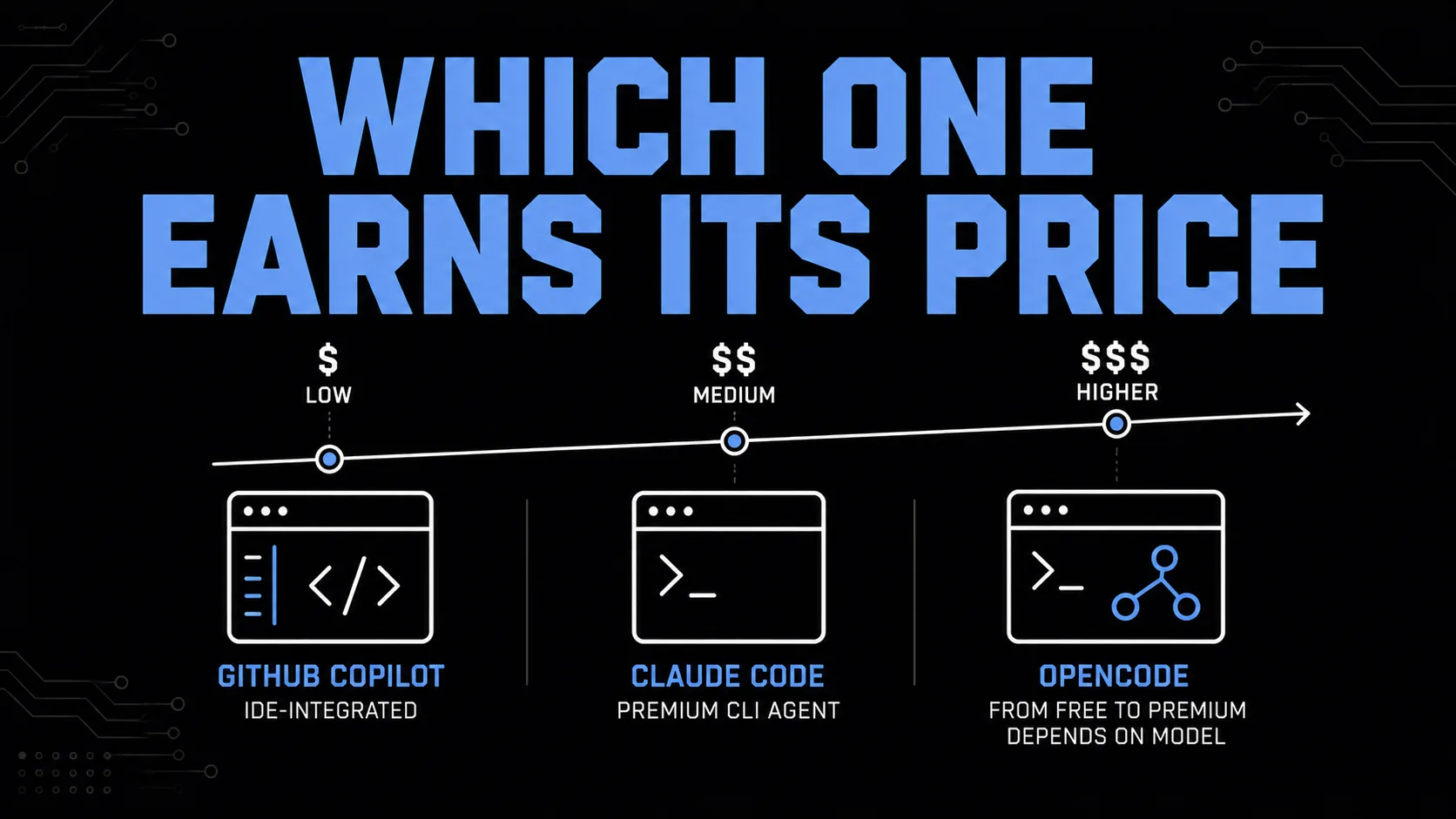
GitHub Copilot vs Claude Code vs OpenCode for Small Teams: Which Is Worth Paying For?
GitHub Copilot is one of the most widely used AI coding tools in the world, and this blog has never once written about it directly. That is not because it seemed unimportant. It is closer to the opposite problem: Copilot is so embedded in GitHub’s own workflow that it rarely gets discussed on its own terms, the way Claude Code or OpenCode do here. We have covered running Claude Code through Opencode Zen for free and given OpenCode a full rundown of its own. Copilot deserves the same treatment, especially for the audience that actually reads a blog like this one: small teams trying to figure out which coding tool is worth an actual line item in the budget, not which one wins a benchmark chart built for enterprise procurement.
This isn’t a feature-by-feature enterprise comparison. It’s a budget comparison for teams of two to fifteen people who need to pick one, maybe two, of these three tools and justify the cost to whoever signs off on software spend.
Quick answer
For most small teams, GitHub Copilot Business, at $19 per seat a month, is the safest default if the team already lives inside GitHub pull requests and wants inline completions plus a lightweight agent with minimal setup. Claude Code is worth paying more for, through a $20 Claude Pro seat or a shared Max plan, when the work is heavier autonomous refactoring and multi-file changes where output quality matters more than the cheapest seat price. OpenCode is worth it specifically when the team wants to control cost directly (down to $0 with free or local models) or wants the freedom to run Claude, GPT, Gemini, or open-weight models through the same terminal workflow. None of the three is a wrong choice. They’re built for different tradeoffs, and small teams often end up leaning on more than one.
What each tool actually is
GitHub Copilot started as inline autocomplete inside VS Code and has grown considerably since. It still does completions, but it now includes an Agent Mode inside IDEs that can edit multiple files, run terminal commands, and iterate on its own, a standalone Copilot coding agent that can be assigned a GitHub issue and open a draft pull request without a human driving each step, and a Copilot CLI that reached general availability in February 2026 for developers who want an agent in the terminal instead of the editor. Its biggest structural advantage is that it never leaves GitHub’s own surface: issues, pull requests, code review, and Actions are all one product.
Claude Code is Anthropic’s own command-line agent. It’s terminal-first by design rather than by afterthought, built around reading and editing real repositories, running shell commands, and handling multi-step engineering tasks end to end. Unlike Copilot or OpenCode, it’s single-vendor: you get Anthropic’s Claude models and nothing else, in exchange for a workflow that many engineers rate highly for repository-wide understanding and multi-file editing.
OpenCode is the open-source alternative we’ve already covered in detail on this blog. It’s also terminal-first, but it’s model-agnostic: it connects to more than 75 model providers, including Anthropic, OpenAI, Google, Bedrock, and local models through Ollama. The tradeoff for that flexibility is more setup. Provider configuration and picking the right model for a given task fall on the team instead of a vendor.
What each one actually costs a small team
GitHub Copilot’s pricing changed structurally on June 1, 2026. Every plan moved from counting “premium requests” to a shared pool of GitHub AI Credits, spent per token rather than per request. Inline completions and next-edit suggestions stay free and unlimited on every paid plan. It’s chat, agent mode, code review, and the CLI that draw from the credit pool.
- Copilot Free: $0, capped completions, no credit pool
- Copilot Pro: $10/month, 1,500 AI Credits
- Copilot Pro+: $39/month, 7,000 AI Credits
- Copilot Max: $100/month, 20,000 AI Credits (an individual plan, not to be confused with Claude’s Max tier)
- Copilot Business: $19/user/month, roughly 1,900 AI Credits per seat
- Copilot Enterprise: $39/user/month, and it requires GitHub Enterprise Cloud, which adds roughly $21 per user a month on top
That last line matters more for this article than any other single fact. Copilot Enterprise isn’t really built for small teams. The licensing prerequisite alone pushes the real cost closer to $60 a seat, a different budget conversation than the one most small teams are having. Business, at $19 a seat, is the tier that actually applies here.
Claude Code has no standalone price of its own. It rides on top of a Claude subscription: Pro at $20 a month, or Max at $100 (5x usage) or $200 (20x usage) a month, shared across Claude Code and Anthropic’s other Claude apps. There is no meaningful free tier for regular Claude Code use, and unlike Copilot’s credit system, exact usage caps on Pro and Max aren’t published as hard numbers.
OpenCode itself costs nothing to install or run, since it’s open source. What a team actually pays is whatever the connected model provider charges, which can range from genuinely $0 (local models through Ollama, or free models through a gateway like Opencode Zen) up to full API rates for frontier models. We worked out the actual math for that scenario in our Claude Code and Opencode Zen cost calculator: light, occasional use lands around $3 to $20 a month per developer, while constant, heavy daily use can climb past $150.
A five-person team, three different monthly bills
Put real numbers against a five-person team and the differences stop being abstract.
All-Copilot Business: 5 seats x $19 comes to $95 a month, credits included, no separate API bill to track.
All-Claude Pro: 5 seats x $20 comes to $100 a month, roughly the same headline cost. But usage caps aren’t published in hard numbers, so a team doing heavy daily agentic work may need to upgrade some or all seats to Max, at which point the bill jumps to $500 or $1,000 a month.
OpenCode on a shared API budget: $0 in license fees, plus whatever the team spends on model tokens. A team that leans on cheaper or local models for routine work, and only reaches for a frontier model on hard problems, can plausibly land under $50 a month total. A team that runs frontier models constantly can also end up spending more than either of the other two options. The number moves with usage in a way a flat seat price doesn’t.
The catch each one doesn’t put on the pricing page
GitHub Copilot’s credit system is new enough that nobody has a full year of real usage data on it yet. A small team doing heavy agentic work through Copilot’s agent mode or coding agent could burn through a seat’s monthly credit allowance faster than expected, at which point additional usage bills at $0.01 per credit. That isn’t a hidden fee exactly, since GitHub documents it, but it is a variable cost sitting inside what looks like a flat $19 seat price.
Claude Code’s catch is vendor concentration. Paying for Claude Pro or Max buys access to Anthropic’s models only. If Claude has an outage, hits a rate limit, or simply isn’t the strongest model for a given task, there’s no fallback inside the same subscription. Cost can also climb quickly for teams running frequent, long agentic sessions, which is exactly what our cost calculator post works through in more detail.
OpenCode’s catch is the one the earlier OpenCode post on this blog already flagged: it shifts the cost from a subscription line item to setup time and ongoing provider management. Someone on the team needs to own model selection, API keys, and rate limits across however many providers get connected. For a small team without anyone who wants that job, the “free” tool has a real, if less visible, cost in hours.
Which one is actually worth paying for
If the team’s daily work already happens inside GitHub pull requests, and the goal is inline help plus a low-friction agent that opens draft PRs against real issues, Copilot Business at $19 a seat is the easiest yes. It’s the cheapest of the three paid options here, and it adds nothing to the toolchain a GitHub-based team doesn’t already have open.
If the work is genuinely heavy, large multi-file refactors, deep debugging sessions, repository-wide changes where output quality is worth paying up for, Claude Code earns its higher price. A $20 Pro seat is a reasonable place to start. Teams that outgrow it will know, because they’ll hit the caps.
If the constraint is the budget itself, or the team wants the flexibility to run different models for different jobs without switching tools, OpenCode is worth the extra setup time. It’s also the only one of the three that can genuinely run at $0 in both license and model cost, for teams willing to lean on free or local models for routine work.
Plenty of small teams land on more than one of these at once: Copilot for the GitHub-native day-to-day, and Claude Code or OpenCode kept around for the harder jobs. Nothing here requires picking exactly one and living with it forever. (For a different kind of comparison entirely, one covering autonomous background agents rather than IDE-integrated assistants, see our look at OpenClaw against Claude Code and OpenCode.)
Frequently asked questions
Is GitHub Copilot still worth paying for in 2026, given how much Claude Code and OpenCode get talked about? Yes, for teams that live inside GitHub’s own workflow. Copilot’s coding agent and code review features are tied directly into pull requests and issues in a way the other two tools don’t replicate, and Business is the cheapest paid seat of the three tools compared here.
Can a small team realistically use GitHub Copilot and Claude Code together? Yes, and it’s common. Nothing stops a developer from using Copilot’s inline completions and coding agent for routine GitHub work while reaching for Claude Code on a terminal for a harder refactor. The cost is additive rather than exclusive, so it comes down to whether the extra seat is worth it for the team’s mix of work.
Is OpenCode actually free, or is that misleading? The software is free and open source. What isn’t necessarily free is the model it talks to. Running frontier models through OpenCode costs the same API rates as running them anywhere else. The savings come from being able to choose cheaper or local models instead of being locked into one vendor’s pricing.
Does GitHub Copilot support Claude models? Yes. Claude Sonnet 5 reached general availability inside GitHub Copilot on June 30, 2026, available through the model picker on Pro, Pro+, Max, Business, and Enterprise plans. Model availability has shifted before and will likely shift again, so check Copilot’s own model picker for what’s currently offered rather than assuming a fixed list.
What’s the cheapest way for a small team to get agentic coding help? OpenCode connected to free or local models is the closest to $0. Among the paid options, Copilot Business at $19 a seat is cheaper than a Claude Pro seat at $20, though the two aren’t doing identical jobs, so “cheapest” and “best value” aren’t the same question.
Is GitHub Copilot Enterprise worth it for a small team? Almost never. It’s priced at $39 a seat but requires GitHub Enterprise Cloud, which adds its own per-seat cost on top, pushing the real price well past what Business already covers. Enterprise is built for organizations with compliance and governance needs that most small teams don’t have yet.